City Council Considers New Tenant Protections and Rental Property License
On June 2, 2026, City Council completed the first reading of Ordinance No. 26C-27, which imposes business regulations for landlords operating within the City. Ordinance No. 26C-27 is a new chapter for Title 5 of the Mercer Island City Code (MICC) – Business License and Regulations. The new chapter requires all landlords within the City to maintain a rental property license and a Business License. The application for the rental property license will require landlords operating within the Town Center and Multifamily zones to certify that they have met specific operational standards. City Council is meeting to hold the second reading on Ordinance No. 26C-27 on June 16, 2026.
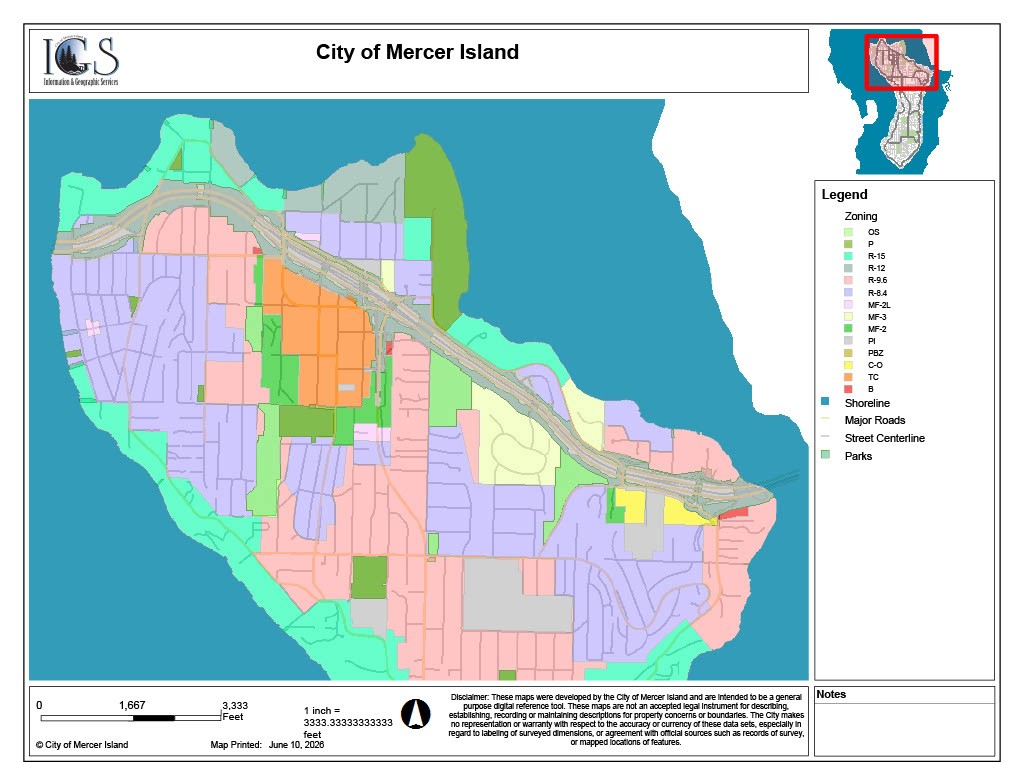 Landlords operating within the Town Center and Multifamily zones have to meet additional operating requirements (TC and MF zones). Mercer Island Zoning Map Source: Mercer Island GIS Hub
https://city-of-mercer-island-gis-hub-mercerislandgis.hub.arcgis.com/ Accessed June 10, 2026.The requirements are limited to these zones to specifically address the displacement risk identified in the Displacement Risk Evaluation. The new operating requirements implement two substantial requirements; Advance Notice of Rent Increase and Relocation Assistance.
Advance Notice of Rent Increase: the operating requirements would require landlords for properties located in the Town Center and Multifamily zones to provide the following notice when increasing rent:
- If the rent increase exceeds a cumulative three percent (3%) within a twelve- (12) month period, the landlord must notify all tenants or subtenants of market rate or income-restricted housing units at least one hundred twenty (120) days prior to the increase taking effect.
- If the rent increase is three percent (3%) or under for market rate units, the state law requires a 90-day notice (RCW 59.18.140).
- If the rent increase for income-restricted units is three percent (3%) or under, the landlord must notify the tenants at least 30-days' prior. Tenants in income-restricted units would be allowed to terminate the tenancy immediately upon surrendering the dwelling unit prior to the increase taking effect. The landlord must inform the tenant of this option in the notice of rent increase.
Relocation Assistance: the operating requirements also require landlords for properties located in the Town Center and Multifamily zones to follow the provisions below for relocation assistance:
- Relocation assistance must be provided to each low-income household (<80% AMI) in the event of rental property demolition, substantial rehabilitation, change of use, and/or removal of rent or income restriction (together, “Relocation Event”).
| Household Size | 80% Area Median Income |
| 1 | $84,850 |
| 2 | $96,950 |
| 3 | $109,050 |
| 4 | $121,150 |
| 5 | $130,850 |
The average Mercer Island household would be considered low income if income is under approximately $100,000 annually. Source: King County Housing Authority https://www.kcha.org/housing/subsidized/eligibility Accessed: June 2, 2026
- For each relocation event, relocation assistance must equal two thousand dollars ($2,000), as provided in RCW 59.18.440(4)(a).
- The payment shall be in addition to the refund of the security deposit or other sums which the tenant is lawfully qualified to receive.
- The landlord must provide each tenant eligible for relocation assistance a written notice at least 90 days prior to a relocation event (“Relocation Notice”). In addition, a copy of the relocation notice would be posted at every entrance to any building containing dwelling units where a relocation event will occur.
- The tenant must provide written intent to vacate the rental property to the landlord.
- The landlord must provide the full relocation assistance amount to each eligible household at least 45 days prior to the relocation event.
- The landlord is then able to apply for reimbursement for half the relocation assistance amount from the City.
The Ordinance No. 26C-27 allows a tenant or landlord to resolve relocation assistance disputes through a Hearing Examiner public hearing. The landlord or tenant will file a written request for a hearing and clearly state specific objection(s) and the relief sought with the City Clerk. There is no filing fee for a hearing request. The Hearing Examiner shall issue a decision within 30 days of the filing of the request for a hearing.
If a landlord is found to be in violation or noncompliance of the chapter, including the operating requirements, they may be found guilty of a misdemeanor and shall be subject to a $500 fine and/or imprisonment for a period not exceeding 90 days or both such fine and imprisonment. Each day that an offense is committed or permitted to continue shall be considered a separate offense.

Thank you for your contribution!
Help us reach out to more people in the community
Share this with family and friends