City Council Identifies GMA Compliance Strategy; Seeks Public Feedback
On February 17, the City Council continued discussions on the strategy to comply with the Growth Management Hearings Board (GMHB) Order, issued in August 2025, which requires the City of Mercer Island to update its Comprehensive Plan and Development regulations by the end of July. City staff and consultants provided a detailed presentation that can be viewed here.
The GMHB Order requires the City to plan for and accommodate housing across a range of affordability levels by creating sufficient land capacity and adopting policies, incentives, and subsidies to support this development. Additionally, the City must adopt a subarea plan for the area surrounding the Sound Transit light rail station and adopt anti-displacement measures aimed at helping tenants stay in the community as lower cost housing is redeveloped.
At the meeting, the City Council approved a phased approach to compliance with the GMHB order (AB 6865). The first phase establishes a transit station subarea and applies required upzones and additional development capacity, to be completed by July 31, 2026. This first phase of work is shown in the map below in dark purple as the “Phase 1 Subarea.” The second phase, which would commence after July 31, 2026, would apply upzones and resulting development capacity increases to the rest of the station area to comply with state requirements implemented by HB 1491 (the Transit Oriented Development (TOD) bill) by December 31, 2029. This second phase of work is shown in the map below in violet as the “Phase 2 Subarea.”
Preliminary Modified Station Area and GMA Compliance Phase 1 and Phase 2 Subareas.
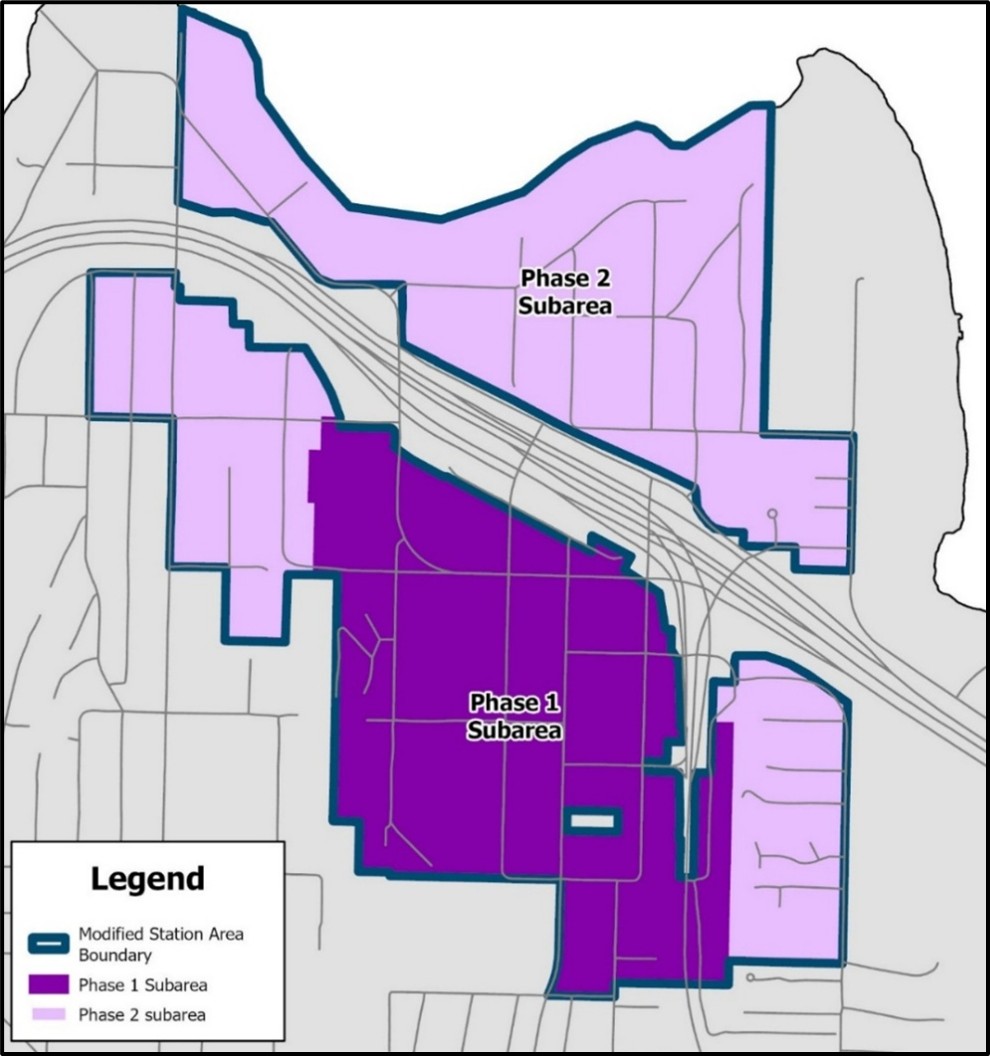
Phase 1 would include upzones to the Town Center and adjacent multi-family zones, increasing maximum allowable building heights to approximately eight stories and six stories, respectively. The land capacity analysis projects a resulting increase in development capacity of 1,031 additional housing units that serve a variety of affordability levels. The City’s analysis also shows that increasing development capacity does not adequately address housing needs for the extremely low-income affordability level (0-30% of area median income). An “affordability gap” of 510 extremely low-income units remains and must be addressed through additional policies, incentives, and subsidies. The City Council has directed staff to continue developing strategies to address this gap.
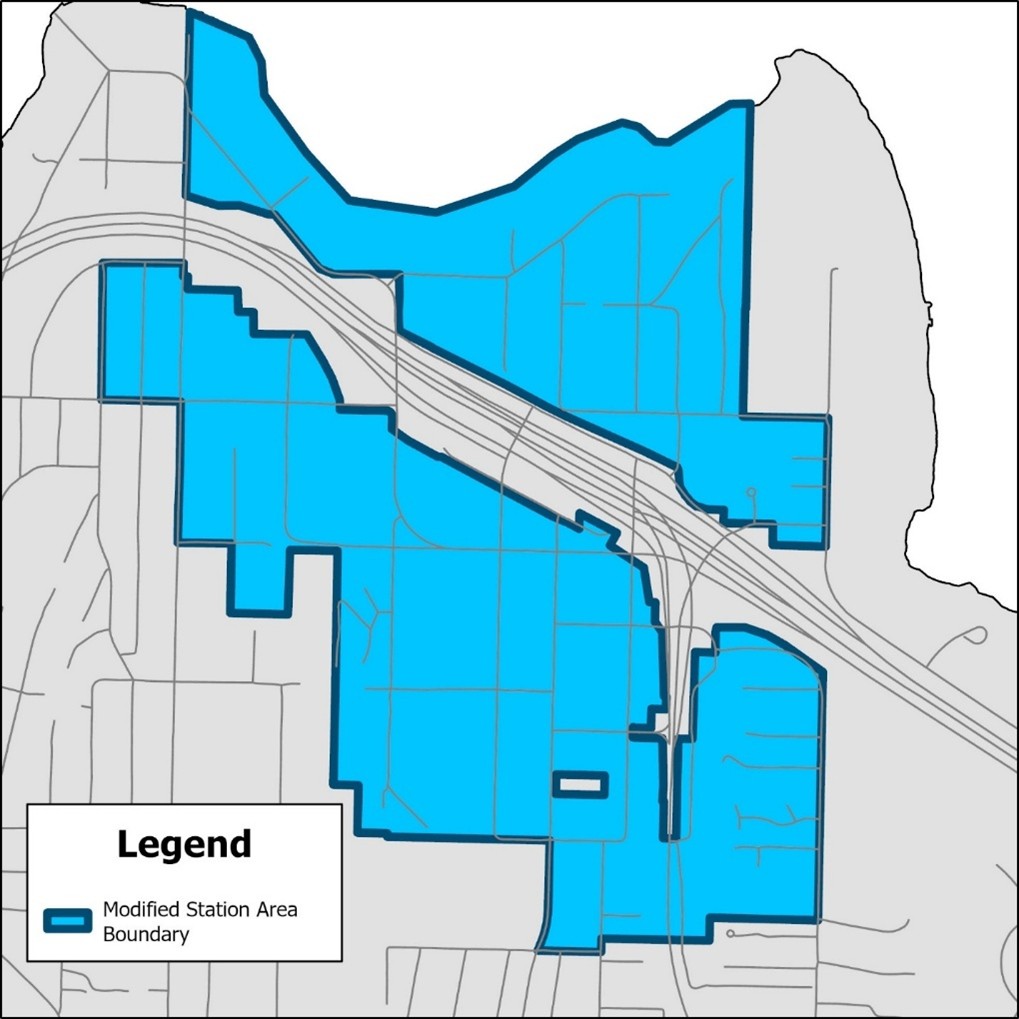
The City Council also reviewed a draft Station Area Boundary (shown in the map below in dark blue), which includes the area within a half mile walk from the light rail station entrances. The GMHB Order requires the City to adopt a subarea plan for this area, which will include goals and policies related to housing, transportation, economic development, infrastructure, and other issues. This plan will help guide work on the Phase 2 rezones as well as future growth and development in the Station Area.
The City Council is seeking public feedback on the proposed Station Area Boundary through March 13, 2026. Please submit comments via the City’s Let’s Talk page.
Preliminary Modified Station Area Boundary
The public is invited to attend a Community Information Session Webinar on Tuesday, March 10 from 6:00 to 7:00 pm to learn more about the appeal of the City’s Comprehensive Plan, the GMHB Order, and the City’s plan to achieve compliance. Register for the webinar here.
To stay informed as the project progresses, visit the City’s Comprehensive Plan GMA Compliance webpage for periodic updates.

Thank you for your contribution!
Help us reach out to more people in the community
Share this with family and friends