Planning for Housing Across Income Levels: Affordable and STEP Housing
The Washington State Growth Management Act (GMA) requires local governments to include a housing element in their comprehensive plan that identifies sufficient land capacity and zoning to accommodate housing for all income segments. Affordable Housing is defined in the GMA as housing that is affordable to those earning at or below 80% of the Area Median Income (AMI). STEP is an acronym for several types of housing, including: shelters, transitional housing, emergency housing, and permanent supportive housing. This article will provide more information on these housing types and the requirements in State law for cities pertaining to providing for this housing.
What is AMI?
Affordable housing is often characterized based on percentages of the Area Median Income, or AMI. AMI is the midpoint of a specific area’s income distribution and is calculated by the U.S. Department of Housing and Urban Development (HUD) each year. The HUD calculation determines median income for a four-person household based on the Census Bureau’s American Community Survey (ACS) data and is adjusted for inflation based on projected per capita wage growth. The geographic area is determined by HUD’s Metro FMR Area definitions.
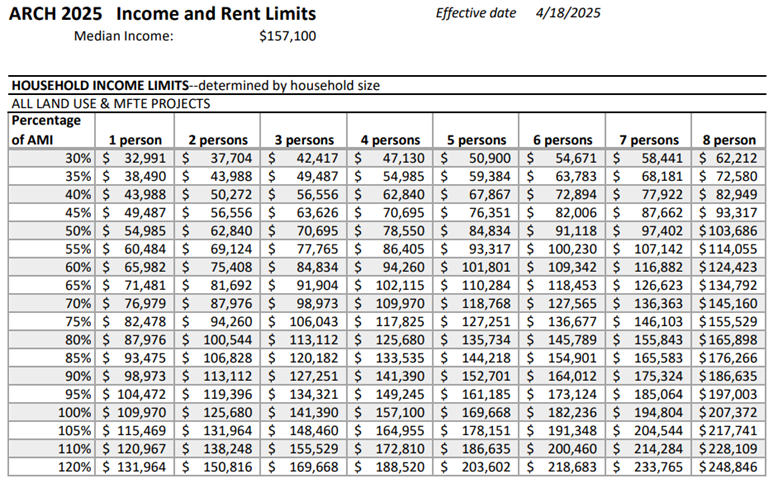
Mercer Island is part of the Seattle-Bellevue, WA Metro FMR Area, which contains King and Snohomish Counties. The 2025 AMI for the Seattle-Bellevue FMR Area is $157,100. AMI can be adjusted based on household size and income level. Below is a table from A Regional Coalition for Housing (ARCH) with 2025 AMI levels based on household size.
Mercer Island’s Housing Needs
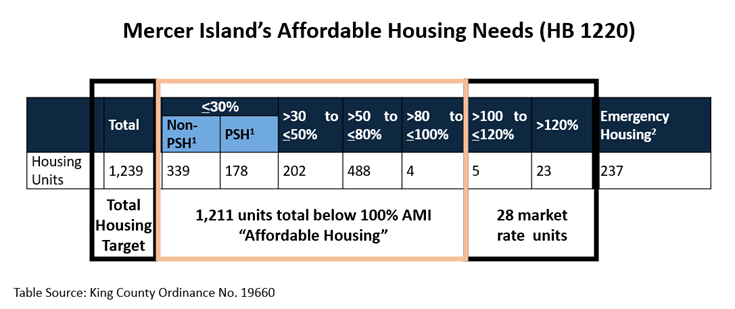
Under the GMA, cities are required to plan for housing needs across income levels. Cities must provide capacity for the identified housing units at each affordability level AND provide "adequate provisions," such as regulations and incentives, to help make this housing available. Housing needs, also referred to as "affordable housing targets," were identified statewide by the Department of Commerce, broken out by county. Counties then allocated housing needs to cities. Mercer Island’s housing needs, as assigned by King County, are shown below. Mercer Island has a total housing target of 1,239 units, of which 1,211 units are affordable housing units. In addition, 237 Emergency Housing beds are needed.
Extremely Low-Income Housing (0-30% AMI)
Mercer Island’s affordable housing targets include 517 units of “extremely low-income” or 0-30% AMI housing units. As shown in the chart above, this housing is for individuals earning less than $32,991 or a family of four earning less than $47,130. These 517 units are further categorized as Permanent Supportive Housing or Other Extremely Low-Income Housing.
Permanent Supportive Housing
178 of the 517 extremely low-income units must be designated as Permanent Supportive Housing or PSH. PSH is defined in the GMA as leased, long-term housing that includes support services (on- or off-site) and is designed to support persons with complex behavioral or physical health conditions and who are experiencing or at imminent risk of homelessness. This housing is intended to be “low barrier,” meaning it utilizes admissions practices that are less rigorous than typical for other subsidized or unsubsidized rental housing, especially related to “rental history, criminal history, and personal behaviors.” RCW 36.70A.030(33). The City must allow this housing in zones that permit residential uses and/or hotels. RCW 35A.21.430.
Other Extremely Low-Income Housing
The remaining 339 extremely low-income units constitute leased, long-term housing for individuals or families that meet the extremely low-income limits (30% AMI or below). This housing does not include support services. Eligibility for this housing can include seniors or people with disabilities on a fixed income as well as people who simply earn a low income. For example, a single parent with one child at home, working full time and earning minimum wage, would fall into this income level.
Other Affordable Housing
Mercer Island’s remaining affordable housing targets correspond to the Very Low-Income (30-50% AMI), Low-Income (50-80% AMI) and Moderate-Income (80-100% AMI) affordability levels. In total, the City must plan to accommodate 694 units across these affordability levels. The City’s consultant, Community Attributes, drafted the 2026 Land Capacity Analysis (LCA) showing that these housing needs can be addressed by unsubsidized, market-rate development when additional development capacity is added to the City.
The City Council has directed a phased approach to adding development capacity, with the Phase 1 upzones focused in and around the Town Center. The LCA shows that the planned upzones are sufficient to provide adequate capacity for the required affordable housing units between 30%-100% AMI.
Emergency Housing and Emergency Shelters
Emergency housing is temporary indoor accommodations for individuals or families who are homeless or at imminent risk of becoming homeless, and it may or may not require a lease or occupancy agreement. RCW 36.70A.030(15). Emergency shelters provide temporary shelter for individuals or families who are currently homeless, may not require a lease or occupancy agreement, and include day and warming centers that do not provide overnight accommodations. RCW 36.70A.030(16).
The City must allow these housing types in zones that allow hotels. RCW 35A.21.430. In addition, the City must provide adequate land capacity to accommodate the 237-bed target for emergency housing and shelters. RCW 36.70A.115.
Emergency housing and emergency shelters are currently regulated through interim regulations (Ordinance No. 26-02). These regulations will need to be replaced with permanent regulations to maintain compliance with state law. The Growth Management Hearings’ Board (“Board”) found the City’s emergency housing regulations in compliance with the GMA. However, recent legislation requires the City to amend these provisions related to spacing and operational requirements. This will be addressed as a part of the effort to comply with the Board's order.
Regulating Affordable, Permanent Supportive and Emergency Housing
Affordable Housing
PSH and other affordable housing are afforded the protections provided in Chapter 36.130. RCW, Affordable Housing Development, which applies to housing that is affordable up to 80% AMI. This means that development regulations applicable to PSH and other affordable housing are regulated by Chapter 36.130 RCW, and cities may not impose requirements that are different than the requirements imposed on housing generally.
Some exceptions to this apply such that conditions may be imposed on affordable housing developments, including PSH, as a prerequisite to receiving optional assistance such as tax benefits, subsidy funds, sale or lease of public property, or eligibility for optional housing incentive programs such as density bonuses, height and bulk bonuses, fee waiver, parking reduction, or expedited permitting. RCW 36.130.020(3), RCW 36.70A.540. If a developer, however, chooses not to participate in an optional program, a city may not condition approval of a permit that is otherwise consistent with development standards. RCW 36.70A.540(1)(c).
Emergency housing and shelters are not “affordable housing,” and are not subject to the protections of Chapter 36.130 RCW. However, recently adopted legislation, HB 2266, limits the regulatory requirements that local jurisdictions may enact. As mentioned above, this housing must be permitted in zones that allow hotels. Additionally, jurisdictions may not require any standards, conditions, or requirements for this housing that are more restrictive than those required for other types of lodging or residential development in the zone.
Occupancy Standards
Occupancy standards regulate who is permitted to live in a specific type of housing. All of the housing types discussed in this memo are subject to Federal and State fair housing and anti-discrimination laws. These laws protect certain groups, generally prohibit discrimination, and apply to the regulation of occupancy. In addition, as outlined above, State law provides that affordable housing must be regulated the same as housing developments generally. RCW 36.130.020. Thus, the City has very little authority to regulate occupancy of PSH or other types of affordable housing.
Additional Resources
Department of Commerce Guidance
Relevant Legislation

Thank you for your contribution!
Help us reach out to more people in the community
Share this with family and friends