Comprehensive Plan GMA Compliance

In 2024, the City of Mercer Island adopted a Comprehensive Plan Periodic Update, which was appealed to the Growth Management Hearings Board in 2025. The appeal resulted in a Final Decision and Order, which requires the City to update the Comprehensive Plan to comply with four requirements by July 31, 2026.

In 2024, the City of Mercer Island adopted a Comprehensive Plan Periodic Update, which was appealed to the Growth Management Hearings Board in 2025. The appeal resulted in a Final Decision and Order, which requires the City to update the Comprehensive Plan to comply with four requirements by July 31, 2026.
-
Planning for Housing Across Income Levels: Affordable and STEP Housing
Share Planning for Housing Across Income Levels: Affordable and STEP Housing on Facebook Share Planning for Housing Across Income Levels: Affordable and STEP Housing on Twitter Share Planning for Housing Across Income Levels: Affordable and STEP Housing on Linkedin Email Planning for Housing Across Income Levels: Affordable and STEP Housing linkThe Washington State Growth Management Act (GMA) requires local governments to include a housing element in their comprehensive plan that identifies sufficient land capacity and zoning to accommodate housing for all income segments. Affordable Housing is defined in the GMA as housing that is affordable to those earning at or below 80% of the Area Median Income (AMI). STEP is an acronym for several types of housing, including: shelters, transitional housing, emergency housing, and permanent supportive housing. This article will provide more information on these housing types and the requirements in State law for cities pertaining to providing for this housing.
What is AMI?
Affordable housing is often characterized based on percentages of the Area Median Income, or AMI. AMI is the midpoint of a specific area’s income distribution and is calculated by the U.S. Department of Housing and Urban Development (HUD) each year. The HUD calculation determines median income for a four-person household based on the Census Bureau’s American Community Survey (ACS) data and is adjusted for inflation based on projected per capita wage growth. The geographic area is determined by HUD’s Metro FMR Area definitions.
Mercer Island is part of the Seattle-Bellevue, WA Metro FMR Area, which contains King and Snohomish Counties. The 2025 AMI for the Seattle-Bellevue FMR Area is $157,100. AMI can be adjusted based on household size and income level. Below is a table from A Regional Coalition for Housing (ARCH) with 2025 AMI levels based on household size.

Mercer Island’s Housing Needs
Under the GMA, cities are required to plan for housing needs across income levels. Cities must provide capacity for the identified housing units at each affordability level AND provide "adequate provisions," such as regulations and incentives, to help make this housing available. Housing needs, also referred to as "affordable housing targets," were identified statewide by the Department of Commerce, broken out by county. Counties then allocated housing needs to cities. Mercer Island’s housing needs, as assigned by King County, are shown below. Mercer Island has a total housing target of 1,239 units, of which 1,211 units are affordable housing units. In addition, 237 Emergency Housing beds are needed.

Extremely Low-Income Housing (0-30% AMI)
Mercer Island’s affordable housing targets include 517 units of “extremely low-income” or 0-30% AMI housing units. As shown in the chart above, this housing is for individuals earning less than $32,991 or a family of four earning less than $47,130. These 517 units are further categorized as Permanent Supportive Housing or Other Extremely Low-Income Housing.
Permanent Supportive Housing
178 of the 517 extremely low-income units must be designated as Permanent Supportive Housing or PSH. PSH is defined in the GMA as leased, long-term housing that includes support services (on- or off-site) and is designed to support persons with complex behavioral or physical health conditions and who are experiencing or at imminent risk of homelessness. This housing is intended to be “low barrier,” meaning it utilizes admissions practices that are less rigorous than typical for other subsidized or unsubsidized rental housing, especially related to “rental history, criminal history, and personal behaviors.” RCW 36.70A.030(33). The City must allow this housing in zones that permit residential uses and/or hotels. RCW 35A.21.430.
Other Extremely Low-Income Housing
The remaining 339 extremely low-income units constitute leased, long-term housing for individuals or families that meet the extremely low-income limits (30% AMI or below). This housing does not include support services. Eligibility for this housing can include seniors or people with disabilities on a fixed income as well as people who simply earn a low income. For example, a single parent with one child at home, working full time and earning minimum wage, would fall into this income level.
Other Affordable Housing
Mercer Island’s remaining affordable housing targets correspond to the Very Low-Income (30-50% AMI), Low-Income (50-80% AMI) and Moderate-Income (80-100% AMI) affordability levels. In total, the City must plan to accommodate 694 units across these affordability levels. The City’s consultant, Community Attributes, drafted the 2026 Land Capacity Analysis (LCA) showing that these housing needs can be addressed by unsubsidized, market-rate development when additional development capacity is added to the City.
The City Council has directed a phased approach to adding development capacity, with the Phase 1 upzones focused in and around the Town Center. The LCA shows that the planned upzones are sufficient to provide adequate capacity for the required affordable housing units between 30%-100% AMI.
Emergency Housing and Emergency Shelters
Emergency housing is temporary indoor accommodations for individuals or families who are homeless or at imminent risk of becoming homeless, and it may or may not require a lease or occupancy agreement. RCW 36.70A.030(15). Emergency shelters provide temporary shelter for individuals or families who are currently homeless, may not require a lease or occupancy agreement, and include day and warming centers that do not provide overnight accommodations. RCW 36.70A.030(16).
The City must allow these housing types in zones that allow hotels. RCW 35A.21.430. In addition, the City must provide adequate land capacity to accommodate the 237-bed target for emergency housing and shelters. RCW 36.70A.115.
Emergency housing and emergency shelters are currently regulated through interim regulations (Ordinance No. 26-02). These regulations will need to be replaced with permanent regulations to maintain compliance with state law. The Growth Management Hearings’ Board (“Board”) found the City’s emergency housing regulations in compliance with the GMA. However, recent legislation requires the City to amend these provisions related to spacing and operational requirements. This will be addressed as a part of the effort to comply with the Board's order.
Regulating Affordable, Permanent Supportive and Emergency Housing
Affordable Housing
PSH and other affordable housing are afforded the protections provided in Chapter 36.130. RCW, Affordable Housing Development, which applies to housing that is affordable up to 80% AMI. This means that development regulations applicable to PSH and other affordable housing are regulated by Chapter 36.130 RCW, and cities may not impose requirements that are different than the requirements imposed on housing generally.
Some exceptions to this apply such that conditions may be imposed on affordable housing developments, including PSH, as a prerequisite to receiving optional assistance such as tax benefits, subsidy funds, sale or lease of public property, or eligibility for optional housing incentive programs such as density bonuses, height and bulk bonuses, fee waiver, parking reduction, or expedited permitting. RCW 36.130.020(3), RCW 36.70A.540. If a developer, however, chooses not to participate in an optional program, a city may not condition approval of a permit that is otherwise consistent with development standards. RCW 36.70A.540(1)(c).
Emergency housing and shelters are not “affordable housing,” and are not subject to the protections of Chapter 36.130 RCW. However, recently adopted legislation, HB 2266, limits the regulatory requirements that local jurisdictions may enact. As mentioned above, this housing must be permitted in zones that allow hotels. Additionally, jurisdictions may not require any standards, conditions, or requirements for this housing that are more restrictive than those required for other types of lodging or residential development in the zone.
Occupancy Standards
Occupancy standards regulate who is permitted to live in a specific type of housing. All of the housing types discussed in this memo are subject to Federal and State fair housing and anti-discrimination laws. These laws protect certain groups, generally prohibit discrimination, and apply to the regulation of occupancy. In addition, as outlined above, State law provides that affordable housing must be regulated the same as housing developments generally. RCW 36.130.020. Thus, the City has very little authority to regulate occupancy of PSH or other types of affordable housing.
Additional Resources
Department of Commerce Guidance
Relevant Legislation
The Washington State Growth Management Act (GMA) requires local governments to include a housing element in their comprehensive plan that identifies sufficient land capacity and zoning to accommodate housing for all income segments. Affordable Housing is defined in the GMA as housing that is affordable to those earning at or below 80% of the Area Median Income (AMI). STEP is an acronym for several types of housing, including: shelters, transitional housing, emergency housing, and permanent supportive housing. This article will provide more information on these housing types and the requirements in State law for cities pertaining to providing for this housing.
What is AMI?
Affordable housing is often characterized based on percentages of the Area Median Income, or AMI. AMI is the midpoint of a specific area’s income distribution and is calculated by the U.S. Department of Housing and Urban Development (HUD) each year. The HUD calculation determines median income for a four-person household based on the Census Bureau’s American Community Survey (ACS) data and is adjusted for inflation based on projected per capita wage growth. The geographic area is determined by HUD’s Metro FMR Area definitions.
Mercer Island is part of the Seattle-Bellevue, WA Metro FMR Area, which contains King and Snohomish Counties. The 2025 AMI for the Seattle-Bellevue FMR Area is $157,100. AMI can be adjusted based on household size and income level. Below is a table from A Regional Coalition for Housing (ARCH) with 2025 AMI levels based on household size.

Mercer Island’s Housing Needs
Under the GMA, cities are required to plan for housing needs across income levels. Cities must provide capacity for the identified housing units at each affordability level AND provide "adequate provisions," such as regulations and incentives, to help make this housing available. Housing needs, also referred to as "affordable housing targets," were identified statewide by the Department of Commerce, broken out by county. Counties then allocated housing needs to cities. Mercer Island’s housing needs, as assigned by King County, are shown below. Mercer Island has a total housing target of 1,239 units, of which 1,211 units are affordable housing units. In addition, 237 Emergency Housing beds are needed.

Extremely Low-Income Housing (0-30% AMI)
Mercer Island’s affordable housing targets include 517 units of “extremely low-income” or 0-30% AMI housing units. As shown in the chart above, this housing is for individuals earning less than $32,991 or a family of four earning less than $47,130. These 517 units are further categorized as Permanent Supportive Housing or Other Extremely Low-Income Housing.
Permanent Supportive Housing
178 of the 517 extremely low-income units must be designated as Permanent Supportive Housing or PSH. PSH is defined in the GMA as leased, long-term housing that includes support services (on- or off-site) and is designed to support persons with complex behavioral or physical health conditions and who are experiencing or at imminent risk of homelessness. This housing is intended to be “low barrier,” meaning it utilizes admissions practices that are less rigorous than typical for other subsidized or unsubsidized rental housing, especially related to “rental history, criminal history, and personal behaviors.” RCW 36.70A.030(33). The City must allow this housing in zones that permit residential uses and/or hotels. RCW 35A.21.430.
Other Extremely Low-Income Housing
The remaining 339 extremely low-income units constitute leased, long-term housing for individuals or families that meet the extremely low-income limits (30% AMI or below). This housing does not include support services. Eligibility for this housing can include seniors or people with disabilities on a fixed income as well as people who simply earn a low income. For example, a single parent with one child at home, working full time and earning minimum wage, would fall into this income level.
Other Affordable Housing
Mercer Island’s remaining affordable housing targets correspond to the Very Low-Income (30-50% AMI), Low-Income (50-80% AMI) and Moderate-Income (80-100% AMI) affordability levels. In total, the City must plan to accommodate 694 units across these affordability levels. The City’s consultant, Community Attributes, drafted the 2026 Land Capacity Analysis (LCA) showing that these housing needs can be addressed by unsubsidized, market-rate development when additional development capacity is added to the City.
The City Council has directed a phased approach to adding development capacity, with the Phase 1 upzones focused in and around the Town Center. The LCA shows that the planned upzones are sufficient to provide adequate capacity for the required affordable housing units between 30%-100% AMI.
Emergency Housing and Emergency Shelters
Emergency housing is temporary indoor accommodations for individuals or families who are homeless or at imminent risk of becoming homeless, and it may or may not require a lease or occupancy agreement. RCW 36.70A.030(15). Emergency shelters provide temporary shelter for individuals or families who are currently homeless, may not require a lease or occupancy agreement, and include day and warming centers that do not provide overnight accommodations. RCW 36.70A.030(16).
The City must allow these housing types in zones that allow hotels. RCW 35A.21.430. In addition, the City must provide adequate land capacity to accommodate the 237-bed target for emergency housing and shelters. RCW 36.70A.115.
Emergency housing and emergency shelters are currently regulated through interim regulations (Ordinance No. 26-02). These regulations will need to be replaced with permanent regulations to maintain compliance with state law. The Growth Management Hearings’ Board (“Board”) found the City’s emergency housing regulations in compliance with the GMA. However, recent legislation requires the City to amend these provisions related to spacing and operational requirements. This will be addressed as a part of the effort to comply with the Board's order.
Regulating Affordable, Permanent Supportive and Emergency Housing
Affordable Housing
PSH and other affordable housing are afforded the protections provided in Chapter 36.130. RCW, Affordable Housing Development, which applies to housing that is affordable up to 80% AMI. This means that development regulations applicable to PSH and other affordable housing are regulated by Chapter 36.130 RCW, and cities may not impose requirements that are different than the requirements imposed on housing generally.
Some exceptions to this apply such that conditions may be imposed on affordable housing developments, including PSH, as a prerequisite to receiving optional assistance such as tax benefits, subsidy funds, sale or lease of public property, or eligibility for optional housing incentive programs such as density bonuses, height and bulk bonuses, fee waiver, parking reduction, or expedited permitting. RCW 36.130.020(3), RCW 36.70A.540. If a developer, however, chooses not to participate in an optional program, a city may not condition approval of a permit that is otherwise consistent with development standards. RCW 36.70A.540(1)(c).
Emergency housing and shelters are not “affordable housing,” and are not subject to the protections of Chapter 36.130 RCW. However, recently adopted legislation, HB 2266, limits the regulatory requirements that local jurisdictions may enact. As mentioned above, this housing must be permitted in zones that allow hotels. Additionally, jurisdictions may not require any standards, conditions, or requirements for this housing that are more restrictive than those required for other types of lodging or residential development in the zone.
Occupancy Standards
Occupancy standards regulate who is permitted to live in a specific type of housing. All of the housing types discussed in this memo are subject to Federal and State fair housing and anti-discrimination laws. These laws protect certain groups, generally prohibit discrimination, and apply to the regulation of occupancy. In addition, as outlined above, State law provides that affordable housing must be regulated the same as housing developments generally. RCW 36.130.020. Thus, the City has very little authority to regulate occupancy of PSH or other types of affordable housing.
Additional Resources
Department of Commerce Guidance
Relevant Legislation
-
Planning Commission Reviews GMA Compliance Project - April 29, 2026
Share Planning Commission Reviews GMA Compliance Project - April 29, 2026 on Facebook Share Planning Commission Reviews GMA Compliance Project - April 29, 2026 on Twitter Share Planning Commission Reviews GMA Compliance Project - April 29, 2026 on Linkedin Email Planning Commission Reviews GMA Compliance Project - April 29, 2026 linkOn April 29, the Planning Commission will begin review of amendments to the Comprehensive Plan and development regulations as well as a proposed Station Subarea Plan related to GMA Compliance Project. At this meeting, Staff will be briefing the Planning Commission on the Station Subarea Plan Goals and Policies and the schedule for the legislative review of necessary amendments to the Comprehensive Plan and Development Regulations. The City has published two planning commission bills for consideration:
-
Planning Commission Bill 26-02: Planning Commission Legislative Review Process
- Exhibit 1: Planning Commission Legislative Review Schedule
-
Planning Commission Bill 26-03: Briefing on Station Subarea Plan Goals and Policies
- Exhibit 1: Station Subarea Plan
The Planning Commission legislative review schedule is as follows:
April 29: Station Subarea Plan
May 6: Comprehensive Plan Amendments
May 13: Development Code Amendments
May 20: Development Code Amendments
May 27: Comprehensive Plan Amendments
June 3: Public Hearing
June 10: Planning Commission Recommendation
June 16: Presentation of Planning Commission Recommendations to City Council
The Planning Commission public meetings will be held at 6:00pm, in the Slater Room at the Mercer Island Community and Event Center, located at 8236 SE 24th Street, Mercer Island. Information to attend virtually can be found using the "Meeting Details" links on the Planning Commission Meetings page.
On April 29, the Planning Commission will begin review of amendments to the Comprehensive Plan and development regulations as well as a proposed Station Subarea Plan related to GMA Compliance Project. At this meeting, Staff will be briefing the Planning Commission on the Station Subarea Plan Goals and Policies and the schedule for the legislative review of necessary amendments to the Comprehensive Plan and Development Regulations. The City has published two planning commission bills for consideration:
-
Planning Commission Bill 26-02: Planning Commission Legislative Review Process
- Exhibit 1: Planning Commission Legislative Review Schedule
-
Planning Commission Bill 26-03: Briefing on Station Subarea Plan Goals and Policies
- Exhibit 1: Station Subarea Plan
The Planning Commission legislative review schedule is as follows:
April 29: Station Subarea Plan
May 6: Comprehensive Plan Amendments
May 13: Development Code Amendments
May 20: Development Code Amendments
May 27: Comprehensive Plan Amendments
June 3: Public Hearing
June 10: Planning Commission Recommendation
June 16: Presentation of Planning Commission Recommendations to City Council
The Planning Commission public meetings will be held at 6:00pm, in the Slater Room at the Mercer Island Community and Event Center, located at 8236 SE 24th Street, Mercer Island. Information to attend virtually can be found using the "Meeting Details" links on the Planning Commission Meetings page.
-
Planning Commission Bill 26-02: Planning Commission Legislative Review Process
-
City Council Direction Following April 21, 2026, Meeting
Share City Council Direction Following April 21, 2026, Meeting on Facebook Share City Council Direction Following April 21, 2026, Meeting on Twitter Share City Council Direction Following April 21, 2026, Meeting on Linkedin Email City Council Direction Following April 21, 2026, Meeting linkAt its regular meeting on April 21, 2026, the City Council provided final direction on the strategy to achieve GMA Compliance. City Council gave the following direction:
- Set the inclusionary zoning requirements at 10% of units to be affordable at 50% AMI when drafting code amendments to comply with the GMHB Order.
- Prohibit adult entertainment and warehousing in the TC-8 subarea when drafting code amendments to comply with the GMHB Order.
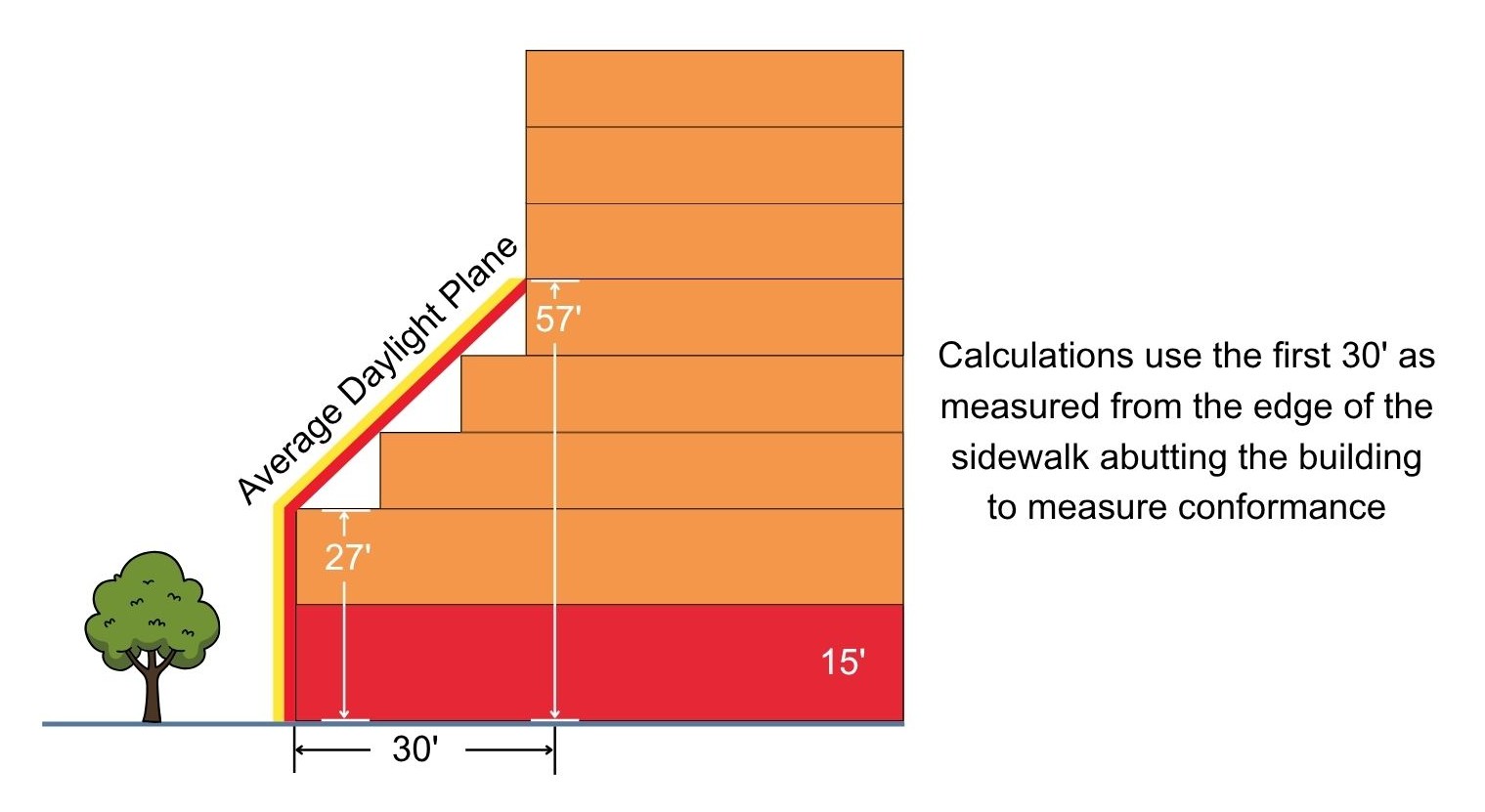
- Include policy direction in the Station Subarea Plan to review the requirements for average daylight plane, major site features, and major façade modulation during Station Subarea Plan Phase 2.
The City Council also directed the Planning Commission to initiate legislative review of the required amendments to the Comprehensive Plan and Development Code, alongside a proposed Station Subarea Plan. The Planning Commission review process begins on April 29 and is scheduled to conclude by June 10 with a formal recommendation to the City Council. The Commission will also hold a public hearing on the proposed amendments on June 3. Following this, the City Council will review the Commission’s recommendations and adopt the necessary ordinances during its meetings throughout June and July. This timeline ensures the City meets the mandatory Growth Management Hearings Board compliance deadline of July 31, 2026.
The Planning Commission legislative review schedule is as follows:
April 29: Station Subarea Plan
May 6: Comprehensive Plan Amendments
May 13: Development Code Amendments
May 20: Development Code Amendments
May 27: Comprehensive Plan Amendments
June 3: Public Hearing
June 10: Planning Commission Recommendation
June 16: Presentation of Planning Commission Recommendations to City Council
The Planning Commission public meetings will be held at 6:00pm, in the Slater Room at the Mercer Island Community and Event Center, located at 8236 SE 24th Street, Mercer Island. Information to attend virtually can be found using the "Meeting Details" links on the Planning Commission Meetings page.
At its regular meeting on April 21, 2026, the City Council provided final direction on the strategy to achieve GMA Compliance. City Council gave the following direction:
- Set the inclusionary zoning requirements at 10% of units to be affordable at 50% AMI when drafting code amendments to comply with the GMHB Order.
- Prohibit adult entertainment and warehousing in the TC-8 subarea when drafting code amendments to comply with the GMHB Order.
- Include policy direction in the Station Subarea Plan to review the requirements for average daylight plane, major site features, and major façade modulation during Station Subarea Plan Phase 2.
The City Council also directed the Planning Commission to initiate legislative review of the required amendments to the Comprehensive Plan and Development Code, alongside a proposed Station Subarea Plan. The Planning Commission review process begins on April 29 and is scheduled to conclude by June 10 with a formal recommendation to the City Council. The Commission will also hold a public hearing on the proposed amendments on June 3. Following this, the City Council will review the Commission’s recommendations and adopt the necessary ordinances during its meetings throughout June and July. This timeline ensures the City meets the mandatory Growth Management Hearings Board compliance deadline of July 31, 2026.
The Planning Commission legislative review schedule is as follows:
April 29: Station Subarea Plan
May 6: Comprehensive Plan Amendments
May 13: Development Code Amendments
May 20: Development Code Amendments
May 27: Comprehensive Plan Amendments
June 3: Public Hearing
June 10: Planning Commission Recommendation
June 16: Presentation of Planning Commission Recommendations to City Council
The Planning Commission public meetings will be held at 6:00pm, in the Slater Room at the Mercer Island Community and Event Center, located at 8236 SE 24th Street, Mercer Island. Information to attend virtually can be found using the "Meeting Details" links on the Planning Commission Meetings page.
-
Next City Council Meeting - April 21, 2026
Share Next City Council Meeting - April 21, 2026 on Facebook Share Next City Council Meeting - April 21, 2026 on Twitter Share Next City Council Meeting - April 21, 2026 on Linkedin Email Next City Council Meeting - April 21, 2026 linkOn April 21, the City Council will receive the next briefing on the Growth Management Hearings Board (GMHB) Order. Staff will be requesting City Council direction on development code amendments and the Planning Commission legislative review schedule. The City has published two agenda bills for consideration:
-
Agenda Bill 6911: GMA Compliance – Legislative Review Process
- Exhibit 1: Planning Commission Legislative Review Schedule
-
Agenda Bill 6909: GMA Compliance – Policy Direction on Development Code Amendments
- Exhibit 1: Inclusionary Zoning and Fee in Lieu of Affordable Housing Policy Brief
- Exhibit 2: Town Center Zoning Amendments Policy Brief
- Continue reading
On April 21, the City Council will receive the next briefing on the Growth Management Hearings Board (GMHB) Order. Staff will be requesting City Council direction on development code amendments and the Planning Commission legislative review schedule. The City has published two agenda bills for consideration:
-
Agenda Bill 6911: GMA Compliance – Legislative Review Process
- Exhibit 1: Planning Commission Legislative Review Schedule
- Agenda Bill 6909: GMA Compliance – Policy Direction on Development Code Amendments
Please see the City of Mercer Island April 21, 2026, meeting webpage for information on how to attend in person or virtually, and how to register to make a public comment.
-
Agenda Bill 6911: GMA Compliance – Legislative Review Process
-
Community Information Session - Public Questions Matrix
Share Community Information Session - Public Questions Matrix on Facebook Share Community Information Session - Public Questions Matrix on Twitter Share Community Information Session - Public Questions Matrix on Linkedin Email Community Information Session - Public Questions Matrix linkThe City of Mercer Island held a virtual webinar on the Growth Management Hearings Board (GMHB) Order and the Comprehensive Plan GMA Compliance Project on the evening of March 10, 2026. The virtual webinar was an opportunity for the City to hear from residents about questions or comments regarding the Comprehensive Plan GMA Compliance Project. Staff prepared responses to the submitted questions in the Public Questions Matrix.
More information on the the virtual webinar is available via the Community Information Session - Recording and Slides article.
The City of Mercer Island held a virtual webinar on the Growth Management Hearings Board (GMHB) Order and the Comprehensive Plan GMA Compliance Project on the evening of March 10, 2026. The virtual webinar was an opportunity for the City to hear from residents about questions or comments regarding the Comprehensive Plan GMA Compliance Project. Staff prepared responses to the submitted questions in the Public Questions Matrix.
More information on the the virtual webinar is available via the Community Information Session - Recording and Slides article.
-
Community Information Session - Recording and Slides
Share Community Information Session - Recording and Slides on Facebook Share Community Information Session - Recording and Slides on Twitter Share Community Information Session - Recording and Slides on Linkedin Email Community Information Session - Recording and Slides linkThe City of Mercer Island held a virtual webinar on the Growth Management Hearings Board (GMHB) Order and the Comprehensive Plan GMA Compliance Project on the evening of March 10, 2026. The recording is available below or through the City Council Community Information Session on GMHB Order webpage. The comments and questions received will be responded to and posted online shortly.
The next opportunity for public input will be at the 5pm March 17, 2026, City Council Meeting located in the Slater Room in the Mercer Island Community & Event Center. The meeting can be attended in person or virtuallyContinue reading
The City of Mercer Island held a virtual webinar on the Growth Management Hearings Board (GMHB) Order and the Comprehensive Plan GMA Compliance Project on the evening of March 10, 2026. The recording is available below or through the City Council Community Information Session on GMHB Order webpage. The comments and questions received will be responded to and posted online shortly.
The next opportunity for public input will be at the 5pm March 17, 2026, City Council Meeting located in the Slater Room in the Mercer Island Community & Event Center. The meeting can be attended in person or virtually - more details are available on the City Council webpage.
The slide deck used in the presentation is available for viewing: Community Information Session Presentation.
The table provided on Slide 18 of the Community Information Session slide deck was truncated for brevity. The full table, below, compares projected housing needs to capacity as presented at the February 17, 2026, City Council meeting (AB6865).
Slide 18: Land Capacity Analysis Table

-
Community Information Session - March 10, 2026
Share Community Information Session - March 10, 2026 on Facebook Share Community Information Session - March 10, 2026 on Twitter Share Community Information Session - March 10, 2026 on Linkedin Email Community Information Session - March 10, 2026 linkJoin us for a virtual webinar on the Growth Management Hearings Board (GMHB) Order and the Comprehensive Plan GMA Compliance Project from 6:00 to 7:00 pm on Tuesday, March 10, 2026. Additional details and registration are available through the link below:
Community Information Session - GMHB Order
Following the appeal of the City's 2024 Comprehensive Plan Periodic Update, the Growth Management Hearings Board (GMHB) issued a Final Decision and Order (GMHB Order) with a compliance deadline of July 31, 2026. The GMHB Order requires the City to address four issues:
- Land Capacity Analysis: Identify residential land capacity at eachContinue reading
Join us for a virtual webinar on the Growth Management Hearings Board (GMHB) Order and the Comprehensive Plan GMA Compliance Project from 6:00 to 7:00 pm on Tuesday, March 10, 2026. Additional details and registration are available through the link below:
Community Information Session - GMHB Order
Following the appeal of the City's 2024 Comprehensive Plan Periodic Update, the Growth Management Hearings Board (GMHB) issued a Final Decision and Order (GMHB Order) with a compliance deadline of July 31, 2026. The GMHB Order requires the City to address four issues:
- Land Capacity Analysis: Identify residential land capacity at each housing affordability level and close any identified gaps.
- Adequate Provisions: Adopt incentives, mandatory provisions, and planned actions that will increase the supply of affordable housing.
- Station Area Subarea Plan: Adopt a subarea plan for the area around the transit station.
- Anti-Displacement Measures: Adopt measures to address the potential displacement that can occur with changes in zoning and redevelopment of lower-cost housing.
Updating the Comprehensive Plan to comply with the GMHB Order will affect Mercer Island in numerous ways. Attend the Information Session Webinar to learn more about the GMHB Order and the City's plans to comply by the July deadline.
-
City Council Identifies GMA Compliance Strategy; Seeks Public Feedback
Share City Council Identifies GMA Compliance Strategy; Seeks Public Feedback on Facebook Share City Council Identifies GMA Compliance Strategy; Seeks Public Feedback on Twitter Share City Council Identifies GMA Compliance Strategy; Seeks Public Feedback on Linkedin Email City Council Identifies GMA Compliance Strategy; Seeks Public Feedback linkOn February 17, the City Council continued discussions on the strategy to comply with the Growth Management Hearings Board (GMHB) Order, issued in August 2025, which requires the City of Mercer Island to update its Comprehensive Plan and Development regulations by the end of July. City staff and consultants provided a detailed presentation that can be viewed here.
The GMHB Order requires the City to plan for and accommodate housing across a range of affordability levels by creating sufficient land capacity and adopting policies, incentives, and subsidies to support this development. Additionally, the City must adopt a subarea planContinue reading
On February 17, the City Council continued discussions on the strategy to comply with the Growth Management Hearings Board (GMHB) Order, issued in August 2025, which requires the City of Mercer Island to update its Comprehensive Plan and Development regulations by the end of July. City staff and consultants provided a detailed presentation that can be viewed here.
The GMHB Order requires the City to plan for and accommodate housing across a range of affordability levels by creating sufficient land capacity and adopting policies, incentives, and subsidies to support this development. Additionally, the City must adopt a subarea plan for the area surrounding the Sound Transit light rail station and adopt anti-displacement measures aimed at helping tenants stay in the community as lower cost housing is redeveloped.
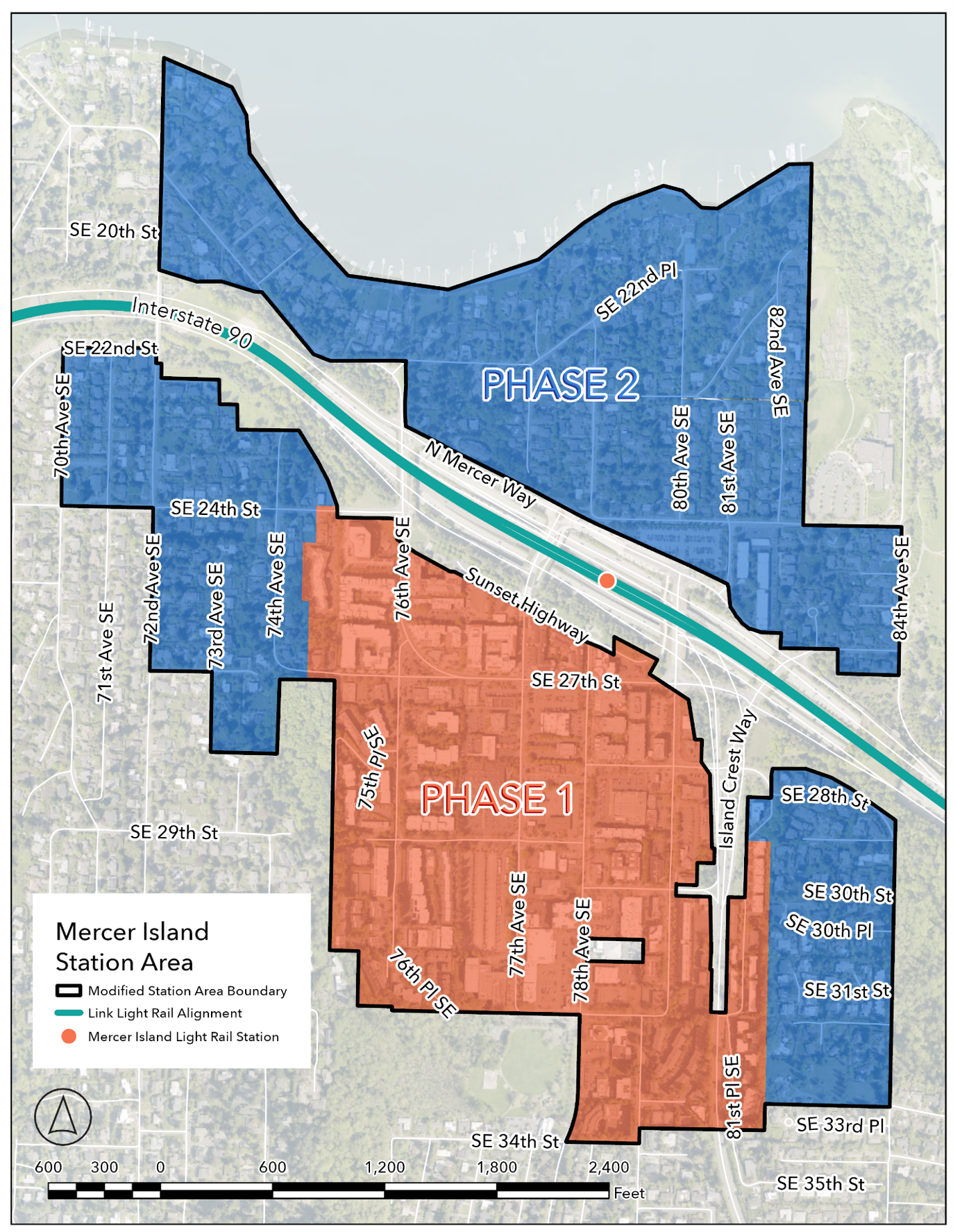
At the meeting, the City Council approved a phased approach to compliance with the GMHB order (AB 6865). The first phase establishes a transit station subarea and applies required upzones and additional development capacity, to be completed by July 31, 2026. This first phase of work is shown in the map below in dark purple as the “Phase 1 Subarea.” The second phase, which would commence after July 31, 2026, would apply upzones and resulting development capacity increases to the rest of the station area to comply with state requirements implemented by HB 1491 (the Transit Oriented Development (TOD) bill) by December 31, 2029. This second phase of work is shown in the map below in violet as the “Phase 2 Subarea.”
Preliminary Modified Station Area and GMA Compliance Phase 1 and Phase 2 Subareas.

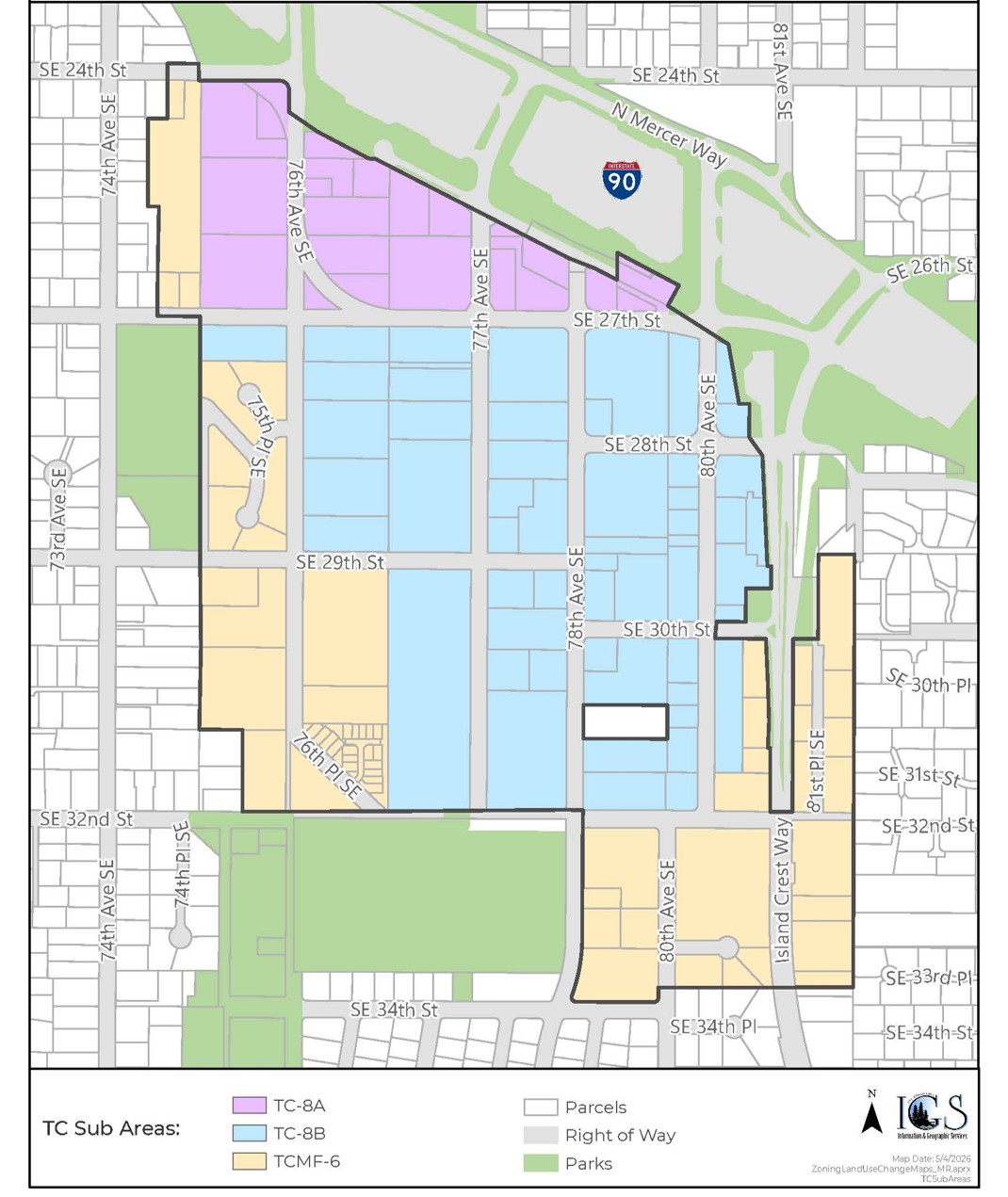
Phase 1 would include upzones to the Town Center and adjacent multi-family zones, increasing maximum allowable building heights to approximately eight stories and six stories, respectively. The land capacity analysis projects a resulting increase in development capacity of 1,031 additional housing units that serve a variety of affordability levels. The City’s analysis also shows that increasing development capacity does not adequately address housing needs for the extremely low-income affordability level (0-30% of area median income). An “affordability gap” of 510 extremely low-income units remains and must be addressed through additional policies, incentives, and subsidies. The City Council has directed staff to continue developing strategies to address this gap.
The City Council also reviewed a draft Station Area Boundary (shown in the map below in dark blue), which includes the area within a half mile walk from the light rail station entrances. The GMHB Order requires the City to adopt a subarea plan for this area, which will include goals and policies related to housing, transportation, economic development, infrastructure, and other issues. This plan will help guide work on the Phase 2 rezones as well as future growth and development in the Station Area.
The City Council is seeking public feedback on the proposed Station Area Boundary through March 13, 2026. Please submit comments via the City’s Let’s Talk page.
Preliminary Modified Station Area Boundary

The public is invited to attend a Community Information Session Webinar on Tuesday, March 10 from 6:00 to 7:00 pm to learn more about the appeal of the City’s Comprehensive Plan, the GMHB Order, and the City’s plan to achieve compliance. Register for the webinar here.
To stay informed as the project progresses, visit the City’s Comprehensive Plan GMA Compliance webpage for periodic updates.
-
Next City Council Briefing - February 17
Share Next City Council Briefing - February 17 on Facebook Share Next City Council Briefing - February 17 on Twitter Share Next City Council Briefing - February 17 on Linkedin Email Next City Council Briefing - February 17 linkOn February 17, 2026, the City Council will receive the next briefing on the Growth Management Hearings Board (GMHB) Order, and the City's compliance strategy. The City has published three agenda bills for consideration:
- AB 6865 and Exhibit 1: Compliance with Growth Management Hearings Board Final Decision and Order Related to the City of Mercer Island Periodic Update to the Comprehensive Plan
- AB 6866 and Exhibit 1: GMA Compliance Public Engagement Plan
- AB 6871 and Exhibit 1: Legislative Review Alternatives to Help City Meet GMHB Order Compliance Deadline
Please see the City of Mercer Island February 17, 2026, meeting webpage for information on how to attend in person or virtually, and how to register to make a public comment.
On February 17, 2026, the City Council will receive the next briefing on the Growth Management Hearings Board (GMHB) Order, and the City's compliance strategy. The City has published three agenda bills for consideration:
- AB 6865 and Exhibit 1: Compliance with Growth Management Hearings Board Final Decision and Order Related to the City of Mercer Island Periodic Update to the Comprehensive Plan
- AB 6866 and Exhibit 1: GMA Compliance Public Engagement Plan
- AB 6871 and Exhibit 1: Legislative Review Alternatives to Help City Meet GMHB Order Compliance Deadline
Please see the City of Mercer Island February 17, 2026, meeting webpage for information on how to attend in person or virtually, and how to register to make a public comment.
-
City Council Commences Work to Develop Compliance Strategy
Share City Council Commences Work to Develop Compliance Strategy on Facebook Share City Council Commences Work to Develop Compliance Strategy on Twitter Share City Council Commences Work to Develop Compliance Strategy on Linkedin Email City Council Commences Work to Develop Compliance Strategy linkAt its annual planning session today, the Mercer Island City Council initiated a strategic effort to align the City’s Comprehensive Plan with state affordable housing requirements. Following a recent Growth Management Hearings Board (GMHB) order requiring the City to revise its plan by July 31, 2026, the Council has committed to a path forward over the coming months to ensure the City meets its obligations.
Under the Washington State Growth Management Act (GMA), cities and counties are required to adopt a comprehensive plan, which is a statement of goals and policies that detail how a county or city will manageContinue reading
At its annual planning session today, the Mercer Island City Council initiated a strategic effort to align the City’s Comprehensive Plan with state affordable housing requirements. Following a recent Growth Management Hearings Board (GMHB) order requiring the City to revise its plan by July 31, 2026, the Council has committed to a path forward over the coming months to ensure the City meets its obligations.
Under the Washington State Growth Management Act (GMA), cities and counties are required to adopt a comprehensive plan, which is a statement of goals and policies that detail how a county or city will manage and accommodate future growth. The goals and policies of the comprehensive plan are implemented through capital investments, development regulations, and programs. The GMA requires cities and counties to periodically review and update their comprehensive plans on a ten-year cycle. Mercer Island most recently completed a periodic review and update of its Comprehensive Plan in 2024 (see AB 6573).
The 2024 Comprehensive Plan was appealed to the GMHB on the grounds that the Comprehensive Plan did not adequately plan for and accommodate future affordable housing needs (GMHB case number 25-3-0003). On Aug. 1, 2025, the GMHB issued a final decision and order (GMHB Order), which found that the City must revise its Comprehensive Plan to comply with the GMA and remanded the Comprehensive Plan to the City for revision. Specifically, the City must amend its Comprehensive Plan to address the following:
- Land Capacity: Analyze residential land capacity at each housing affordability level and close any identified gaps.
- Adequate Provisions: Adopt incentives, mandatory provisions, and planned actions (“aka adequate provisions”) that will increase the supply of affordable housing.
- Station Area Subarea Plan: Adopt a subarea plan for the area around the transit station.
- Anti-Displacement Measures: Adopt anti-displacement measures to address the potential displacement that can occur with changes in zoning.
Although the Comprehensive Plan adopted in 2024 remains in effect during the remand, the City must update the plan and comply by July 31, 2026, which is one year from the date that the GHMB issued its decision, as established by the GMHB Order (RCW 36.70A.300(3)(b)). Failure to comply with the GMHB Order can result in sanctions against the City (RCW 36.70A.340).
Staff began developing compliance strategies and presented proposed options for City Council consideration and direction on Jan. 16, 2026. The Council provided direction on the preferred strategies and requested additional analysis, implementation options and a refined work plan and schedule for Council consideration in February and March of 2026. Based on the City Council direction, Mercer Island will evaluate how compliance with another state law, House Bill 1491, may efficiently address the GMHB Order. Compliance work will continue thereafter with regular City Council briefings and direction, until compliance is achieved.
Key Dates
-
July 31 2026
-
September 15 2026
Important Links
FAQ & Definitions
- What does appeal mean?
- What is a Comprehensive Plan?
- What is a Comprehensive Plan Periodic Update?
- What is the Growth Management Act (GMA) and how does it affect this process?
- Who is the Growth Management Hearings Board?
- What is Displacement?
- What is Zoning?
- What is Land Capacity?
- What does Adequate Provisions mean?
- What is the Station Area Subarea Plan?
- What are Anti-Displacement Measures?
- What is Inclusionary Zoning?
- What is Multifamily Tax Exemption (MFTE)?
- What are Critical Areas?
- What does Affordability really mean?
- What is Transit-Oriented Development (TOD)?
Who's Listening
-
JT
Phone (206) 275-7732 Email jeff.thomas@mercerisland.gov -
-
Principal Planner
AZ -
Assistant Planner
MN -
CC
Email council@mercerisland.gov