Comprehensive Plan GMA Compliance

In 2024, the City of Mercer Island adopted a Comprehensive Plan Periodic Update, which was appealed to the Growth Management Hearings Board in 2025. The appeal resulted in a Final Decision and Order, which requires the City to update the Comprehensive Plan to comply with four requirements by July 31, 2026.

In 2024, the City of Mercer Island adopted a Comprehensive Plan Periodic Update, which was appealed to the Growth Management Hearings Board in 2025. The appeal resulted in a Final Decision and Order, which requires the City to update the Comprehensive Plan to comply with four requirements by July 31, 2026.
-
Planning Commission Recommendation Moving to City Council on June 16
Share Planning Commission Recommendation Moving to City Council on June 16 on Facebook Share Planning Commission Recommendation Moving to City Council on June 16 on X (formerly Twitter) Share Planning Commission Recommendation Moving to City Council on June 16 on Linkedin Email Planning Commission Recommendation Moving to City Council on June 16 linkOn June 3 and June 10, the Planning Commission held a public hearing on proposed updates to the Comprehensive Plan, Development Code, and proposed Station Subarea Plan (PCB26-07 & PCB26-08*). These revisions address the Growth Management Hearings Board order by expanding affordable housing capacity, updating Town Center zoning and development regulations, and implementing a new Station Subarea Plan.
In order to comply with the Growth Management Hearing Board (GMHB) order, the Town Center and surrounding multifamily areas are proposed for upzoning and other changes to the development regulations to increase development capacity, provide additional opportunities for affordable housing development, and implement the Station Subarea Plan. The Planning Commission public hearing covered the following:
- The Comprehensive Plan was amended to reflect the changes required by the GMHB Order.
- An updated Land Capacity Analysis to estimate the capacity of Town Center under new zoning regulations. The analysis estimated the affordability levels of new units in the Town Center.
- 2026 Housing Barriers Analysis evaluating potential barriers to housing production
- The Land Use Map was updated to reflect changes in Town Center and adjacent multifamily
- Amendments to the Transportation, Utilities and Capital Facilities Elements to reflect impacts of additional housing development on the City’s infrastructure
- Amendments to the Town Center Development Code.
- Updated zoning map shows the zoning changes around Town Center and would replace the existing zoning map in Title 19 MICC – Appendix D
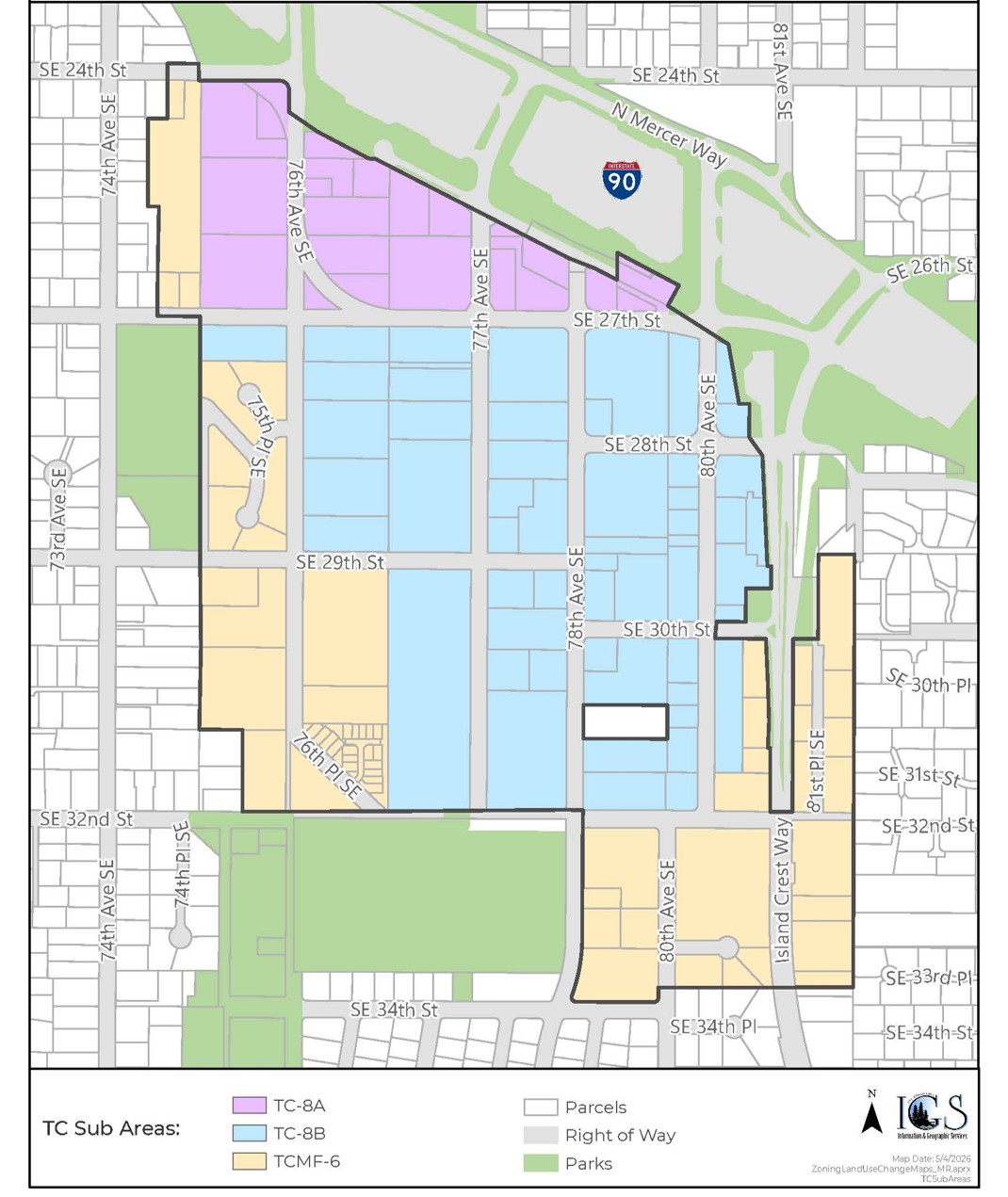
- Increases to maximum building height allowance to 8 stories in the new TC-8A and TC-8B subareas and 6 stories in the new TCMF-6 subarea.
- Code amendments to resolve potential barriers to housing production
- New inclusionary zoning requirement and fee in lieu option
- Station Subarea Plan to provide detailed planning for the area surrounding the light rail station.
Comprehensive Plan and Town Center Amendments
The updated zoning map has changes around Town Center and would replace the existing zoning map in Title 19 MICC – Appendix D The updated comprehensive plan includes provisions for affordable housing in the updated Town Center zone through inclusionary zoning and a fee in lieu program.- Inclusionary zoning is a type of zoning that requires a certain percentage of dwelling units to be affordable housing units. Following adoption, 10% of housing units must be affordable at 50% of the area median income for developments in TC-8A, TC-8B, and TCMF-6 subareas of the Town Center, per MICC 19.11.040
- Fee in lieu is an option to pay a fee to the City instead of constructing the affordable housing required under inclusionary zoning. The fund will be used to finance projects with very low-income dwelling units and permanent supportive housing, which is typically not created through regular market development. The amendments are included in Chapter 19.06 MICC.
Additional code amendments included changes to MICC 19.06.080 for permanent supportive and emergency housing regulations to better accommodate special needs and social service transitional housing. General code amendments were made for consistency to the Comprehensive Plan, Station Subarea Plan, and elsewhere in the development code. Zoning changes will add development capacity and implement Phase 1 of the Station Subarea Plan.
Station Subarea Plan
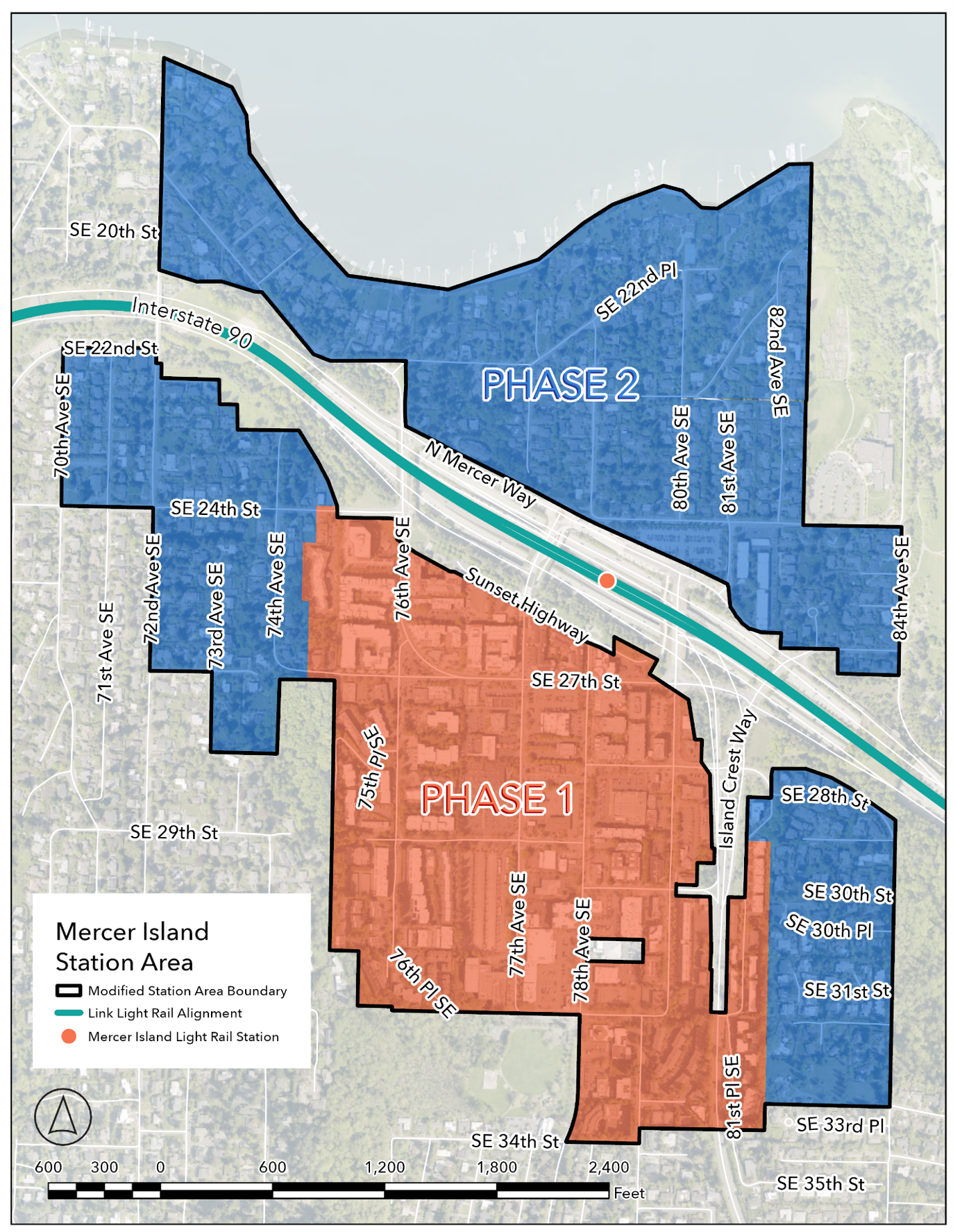
The Station Subarea Plan is a major element towards compliance with the GMHB order. The Station Subarea plan is a set of goals and policies for the area within walking distance from the Mercer Island Light Rail Station. It is part of the Comprehensive Plan that establishes a refined plan for the subarea. The Station Subarea Plan is being implemented in a phased approach; Phase 1 will include upzoning and affordable housing requirements within the existing Town Center and adjacent multifamily zones by July 2026; Phase 2 will include additional zoning and development regulation changes for the entire Station Area by 2029. Work will begin on Phase 2 following adoption of the Station Subarea Plan.
Phase 1 proposed zoning amendments include:
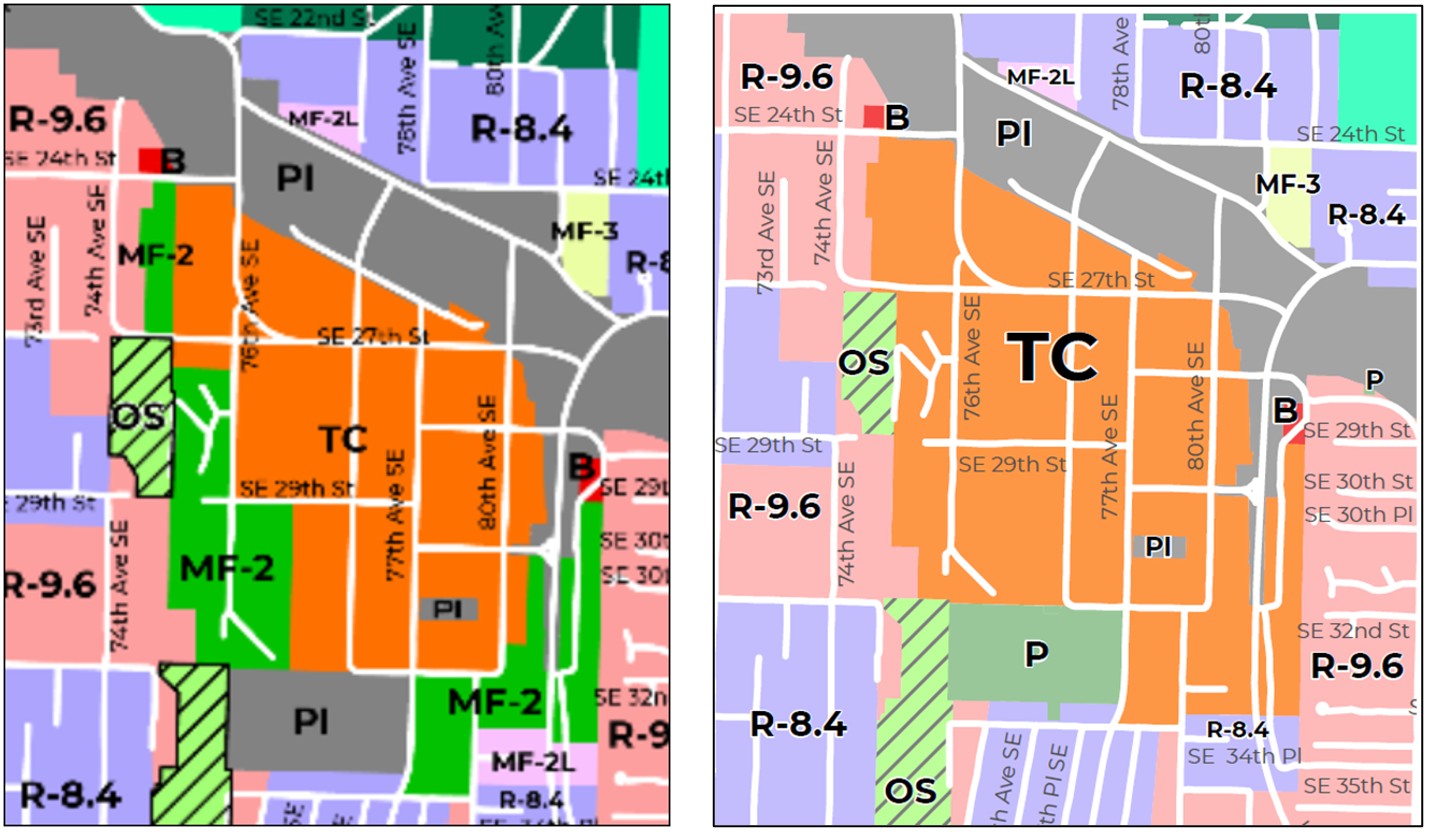
- Consolidating Town Center and adjacent Multi-family (MF-2 and MF-2L) zones into the Town Center Zone
- The current TC increases to a maximum building height of 8-Stories (TC-8A and TC-8B)
- Previous MF zones become a new subarea of Town Center with a 6-Story maximum building height (TCMF-6)
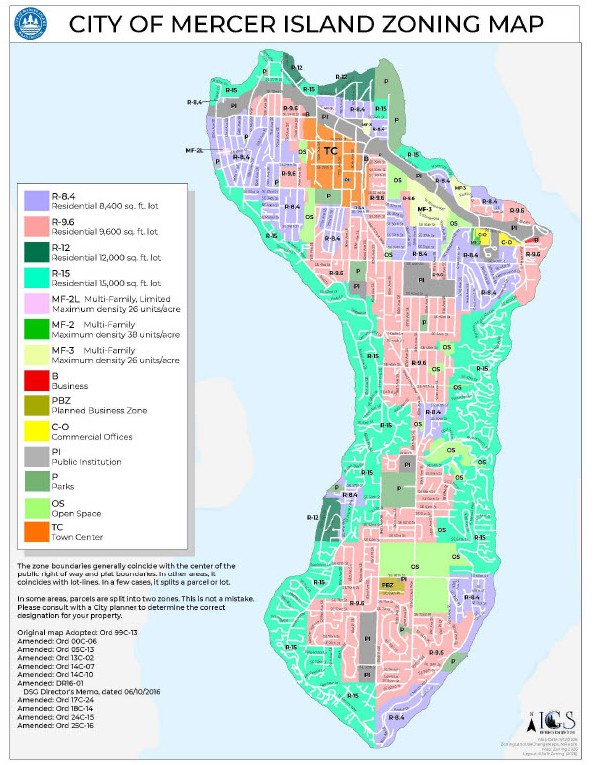
The previous zoning map (left) compared to the updated zoning map (right). The Town Center zone is expanding to include the zones that were previously multifamily. On June 3, the Planning Commission made two motions:
- Incorporate the non-substantive amendments listed in PCB26-07 into the draft Comprehensive Plan, Station Subarea Plan, and Implementing Development Code Amendments.
- Request that staff make clarifying amendments to daylight plane standards related to Development Code, Log 29.
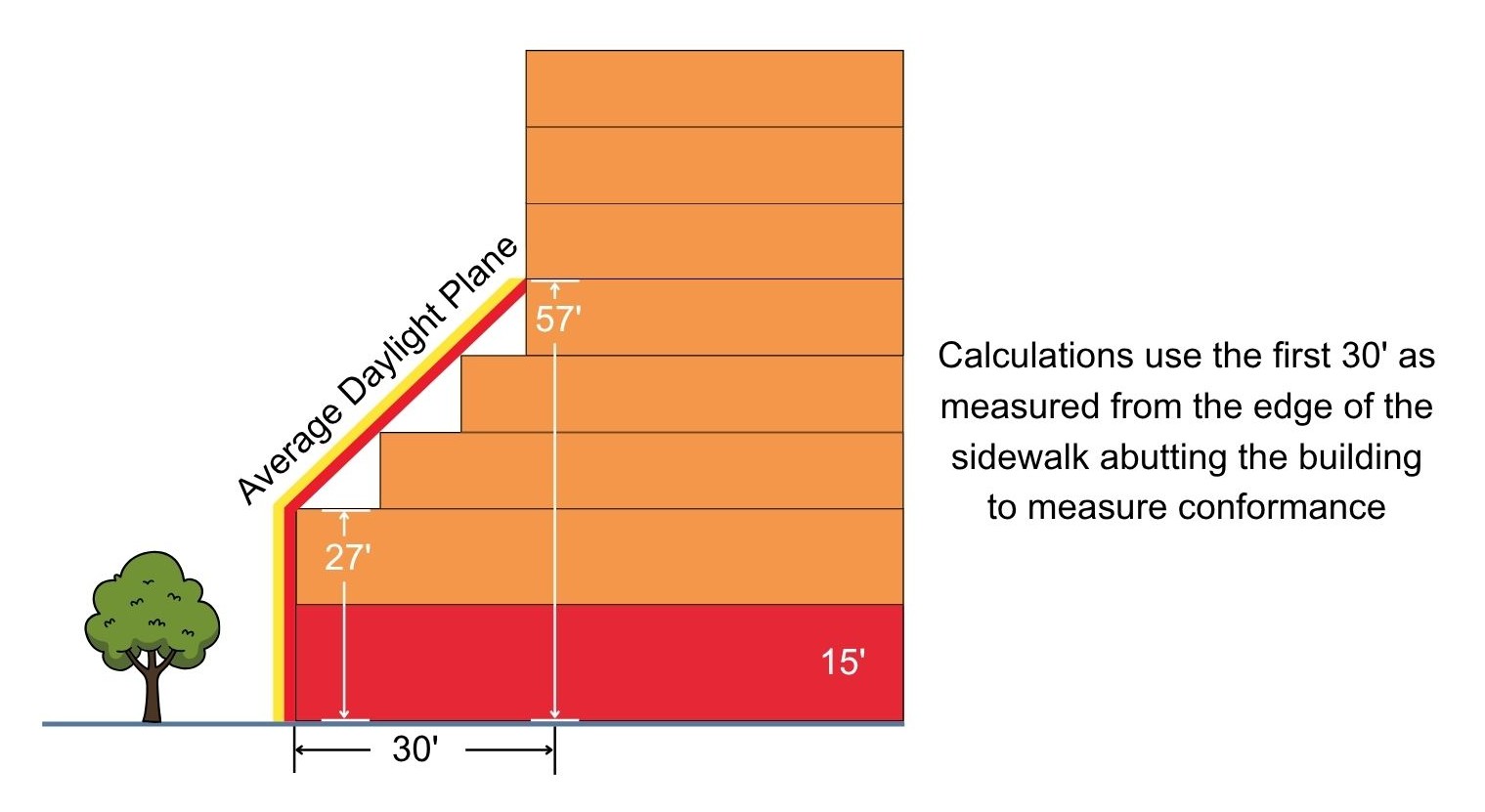
On June 10, the Planning Commission reconvened to resolve the motion made regarding the daylight plane presented at the June 2 meeting. The daylight plane is a development standard that requires the upper floors of buildings to step back to allow more sunlight to reach the street. Following the staff presentation and discussion, the Planning Commission made the following motion to the Town Center development code:
Updated graphic depicting the daylight plane standard in MICC 19.11.030(A)(7)(b)(i).At the end of the public hearing, the Planning Commission’s recommended to City Council to adopt the updated Comprehensive Plan, Station Subarea Plan, and Town Center Development Amendments as presented and amended.
On June 16, the Planning Commission recommendation will be presented to the City Council.
*Materials presented at the June 3 and June 10 public hearing can be viewed below.
June 3 Materials
Planning Commission Bill 26-07: Public Hearing: Comprehensive Plan Update, Station Subarea Plan, and Implementing Development Code Amendments
- Planning Commission Bill Exhibit 1: Amended Comprehensive Plan
- Planning Commission Bill Exhibit 2: Station Subarea Plan
- Planning Commission Bill Exhibit 3: Implementing Development Code Amendments
- Planning Commission Bill Exhibit 4: Planning Commission Comment Matrixes
June 10 Materials
-
Planning Commission Bill 26-08: Public Hearing (Continued): Comprehensive Plan Update, Station Subarea Plan, and Implementing Development Code Amendments
-
Planning Commission Bill Exhibit 1: Amended Comprehensive Plan
- Appendix I: Land Capacity Analysis (p. 159)
- Appendix J: Barriers Analysis (p. 214)
- Planning Commission Bill Exhibit 2: Station Subarea Plan
- Planning Commission Bill Exhibit 3: Implementing Development Code Amendments
- Planning Commission Bill Exhibit 4: Written Public Comment Index
-
Planning Commission Bill Exhibit 1: Amended Comprehensive Plan
Technical Documents
On June 3 and June 10, the Planning Commission held a public hearing on proposed updates to the Comprehensive Plan, Development Code, and proposed Station Subarea Plan (PCB26-07 & PCB26-08*). These revisions address the Growth Management Hearings Board order by expanding affordable housing capacity, updating Town Center zoning and development regulations, and implementing a new Station Subarea Plan.
In order to comply with the Growth Management Hearing Board (GMHB) order, the Town Center and surrounding multifamily areas are proposed for upzoning and other changes to the development regulations to increase development capacity, provide additional opportunities for affordable housing development, and implement the Station Subarea Plan. The Planning Commission public hearing covered the following:
- The Comprehensive Plan was amended to reflect the changes required by the GMHB Order.
- An updated Land Capacity Analysis to estimate the capacity of Town Center under new zoning regulations. The analysis estimated the affordability levels of new units in the Town Center.
- 2026 Housing Barriers Analysis evaluating potential barriers to housing production
- The Land Use Map was updated to reflect changes in Town Center and adjacent multifamily
- Amendments to the Transportation, Utilities and Capital Facilities Elements to reflect impacts of additional housing development on the City’s infrastructure
- Amendments to the Town Center Development Code.
- Updated zoning map shows the zoning changes around Town Center and would replace the existing zoning map in Title 19 MICC – Appendix D
- Increases to maximum building height allowance to 8 stories in the new TC-8A and TC-8B subareas and 6 stories in the new TCMF-6 subarea.
- Code amendments to resolve potential barriers to housing production
- New inclusionary zoning requirement and fee in lieu option
- Station Subarea Plan to provide detailed planning for the area surrounding the light rail station.
Comprehensive Plan and Town Center Amendments
The updated zoning map has changes around Town Center and would replace the existing zoning map in Title 19 MICC – Appendix D The updated comprehensive plan includes provisions for affordable housing in the updated Town Center zone through inclusionary zoning and a fee in lieu program.- Inclusionary zoning is a type of zoning that requires a certain percentage of dwelling units to be affordable housing units. Following adoption, 10% of housing units must be affordable at 50% of the area median income for developments in TC-8A, TC-8B, and TCMF-6 subareas of the Town Center, per MICC 19.11.040
- Fee in lieu is an option to pay a fee to the City instead of constructing the affordable housing required under inclusionary zoning. The fund will be used to finance projects with very low-income dwelling units and permanent supportive housing, which is typically not created through regular market development. The amendments are included in Chapter 19.06 MICC.
Additional code amendments included changes to MICC 19.06.080 for permanent supportive and emergency housing regulations to better accommodate special needs and social service transitional housing. General code amendments were made for consistency to the Comprehensive Plan, Station Subarea Plan, and elsewhere in the development code. Zoning changes will add development capacity and implement Phase 1 of the Station Subarea Plan.
Station Subarea Plan
The Station Subarea Plan is a major element towards compliance with the GMHB order. The Station Subarea plan is a set of goals and policies for the area within walking distance from the Mercer Island Light Rail Station. It is part of the Comprehensive Plan that establishes a refined plan for the subarea. The Station Subarea Plan is being implemented in a phased approach; Phase 1 will include upzoning and affordable housing requirements within the existing Town Center and adjacent multifamily zones by July 2026; Phase 2 will include additional zoning and development regulation changes for the entire Station Area by 2029. Work will begin on Phase 2 following adoption of the Station Subarea Plan.
Phase 1 proposed zoning amendments include:
- Consolidating Town Center and adjacent Multi-family (MF-2 and MF-2L) zones into the Town Center Zone
- The current TC increases to a maximum building height of 8-Stories (TC-8A and TC-8B)
- Previous MF zones become a new subarea of Town Center with a 6-Story maximum building height (TCMF-6)
The previous zoning map (left) compared to the updated zoning map (right). The Town Center zone is expanding to include the zones that were previously multifamily. On June 3, the Planning Commission made two motions:
- Incorporate the non-substantive amendments listed in PCB26-07 into the draft Comprehensive Plan, Station Subarea Plan, and Implementing Development Code Amendments.
- Request that staff make clarifying amendments to daylight plane standards related to Development Code, Log 29.
On June 10, the Planning Commission reconvened to resolve the motion made regarding the daylight plane presented at the June 2 meeting. The daylight plane is a development standard that requires the upper floors of buildings to step back to allow more sunlight to reach the street. Following the staff presentation and discussion, the Planning Commission made the following motion to the Town Center development code:
Updated graphic depicting the daylight plane standard in MICC 19.11.030(A)(7)(b)(i).At the end of the public hearing, the Planning Commission’s recommended to City Council to adopt the updated Comprehensive Plan, Station Subarea Plan, and Town Center Development Amendments as presented and amended.
On June 16, the Planning Commission recommendation will be presented to the City Council.
*Materials presented at the June 3 and June 10 public hearing can be viewed below.
June 3 Materials
Planning Commission Bill 26-07: Public Hearing: Comprehensive Plan Update, Station Subarea Plan, and Implementing Development Code Amendments
- Planning Commission Bill Exhibit 1: Amended Comprehensive Plan
- Planning Commission Bill Exhibit 2: Station Subarea Plan
- Planning Commission Bill Exhibit 3: Implementing Development Code Amendments
- Planning Commission Bill Exhibit 4: Planning Commission Comment Matrixes
June 10 Materials
-
Planning Commission Bill 26-08: Public Hearing (Continued): Comprehensive Plan Update, Station Subarea Plan, and Implementing Development Code Amendments
-
Planning Commission Bill Exhibit 1: Amended Comprehensive Plan
- Appendix I: Land Capacity Analysis (p. 159)
- Appendix J: Barriers Analysis (p. 214)
- Planning Commission Bill Exhibit 2: Station Subarea Plan
- Planning Commission Bill Exhibit 3: Implementing Development Code Amendments
- Planning Commission Bill Exhibit 4: Written Public Comment Index
-
Planning Commission Bill Exhibit 1: Amended Comprehensive Plan
Technical Documents
- The Comprehensive Plan was amended to reflect the changes required by the GMHB Order.
-
City Council Public Hearing - June 16, 2026
Share City Council Public Hearing - June 16, 2026 on Facebook Share City Council Public Hearing - June 16, 2026 on X (formerly Twitter) Share City Council Public Hearing - June 16, 2026 on Linkedin Email City Council Public Hearing - June 16, 2026 linkOn June 16, the City Council will be briefed on the Planning Commissions recommendation regarding the Comprehensive Plan, Station Subarea Plan, and Town Center Development Regulations. The Title 5 Amendments Anti-Displacement Measures are included on the consent agenda for a second reading.
-
Agenda Bill 6945: GMA Compliance – MICC Title 5 Amendments Anti-Displacement Measures (Second Reading, Ordinance No. 26C-07)
- Exhibit 1: Ordinance No. 26C-07
-
Agenda Bill 6947: GMA Compliance – Presentation of Planning Commission Recommendations
- Exhibit 1: Planning Commission Recommendation
Please see the City Council June 16, 2026, meeting webpage for information on how to attend in person or virtually, and how to register to make a public comment.
On June 16, the City Council will be briefed on the Planning Commissions recommendation regarding the Comprehensive Plan, Station Subarea Plan, and Town Center Development Regulations. The Title 5 Amendments Anti-Displacement Measures are included on the consent agenda for a second reading.
-
Agenda Bill 6945: GMA Compliance – MICC Title 5 Amendments Anti-Displacement Measures (Second Reading, Ordinance No. 26C-07)
- Exhibit 1: Ordinance No. 26C-07
-
Agenda Bill 6947: GMA Compliance – Presentation of Planning Commission Recommendations
- Exhibit 1: Planning Commission Recommendation
Please see the City Council June 16, 2026, meeting webpage for information on how to attend in person or virtually, and how to register to make a public comment.
-
Agenda Bill 6945: GMA Compliance – MICC Title 5 Amendments Anti-Displacement Measures (Second Reading, Ordinance No. 26C-07)
-
City Council Considers New Tenant Protections and Rental Property License
Share City Council Considers New Tenant Protections and Rental Property License on Facebook Share City Council Considers New Tenant Protections and Rental Property License on X (formerly Twitter) Share City Council Considers New Tenant Protections and Rental Property License on Linkedin Email City Council Considers New Tenant Protections and Rental Property License linkOn June 2, 2026, City Council completed the first reading of Ordinance No. 26C-27, which imposes business regulations for landlords operating within the City. Ordinance No. 26C-27 is a new chapter for Title 5 of the Mercer Island City Code (MICC) – Business License and Regulations. The new chapter requires all landlords within the City to maintain a rental property license and a Business License. The application for the rental property license will require landlords operating within the Town Center and Multifamily zones to certify that they have met specific operational standards. City Council is meeting to hold the second reading on Ordinance No. 26C-27 on June 16, 2026.
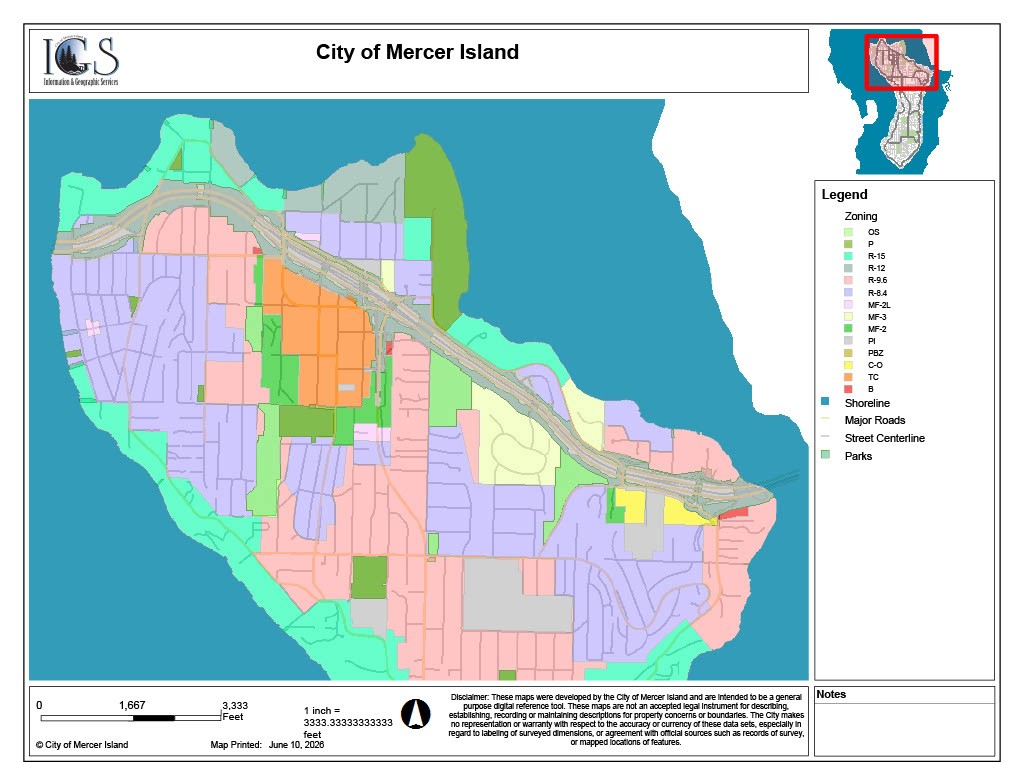
Landlords operating within the Town Center and Multifamily zones have to meet additional operating requirements (TC and MF zones). Mercer Island Zoning Map Source: Mercer Island GIS Hub
https://city-of-mercer-island-gis-hub-mercerislandgis.hub.arcgis.com/ Accessed June 10, 2026.The requirements are limited to these zones to specifically address the displacement risk identified in the Displacement Risk Evaluation. The new operating requirements implement two substantial requirements; Advance Notice of Rent Increase and Relocation Assistance.Advance Notice of Rent Increase: the operating requirements would require landlords for properties located in the Town Center and Multifamily zones to provide the following notice when increasing rent:
- If the rent increase exceeds a cumulative three percent (3%) within a twelve- (12) month period, the landlord must notify all tenants or subtenants of market rate or income-restricted housing units at least one hundred twenty (120) days prior to the increase taking effect.
- If the rent increase is three percent (3%) or under for market rate units, the state law requires a 90-day notice (RCW 59.18.140).
- If the rent increase for income-restricted units is three percent (3%) or under, the landlord must notify the tenants at least 30-days' prior. Tenants in income-restricted units would be allowed to terminate the tenancy immediately upon surrendering the dwelling unit prior to the increase taking effect. The landlord must inform the tenant of this option in the notice of rent increase.
Relocation Assistance: the operating requirements also require landlords for properties located in the Town Center and Multifamily zones to follow the provisions below for relocation assistance:
- Relocation assistance must be provided to each low-income household (<80% AMI) in the event of rental property demolition, substantial rehabilitation, change of use, and/or removal of rent or income restriction (together, “Relocation Event”).
Household Size 80% Area Median Income 1 $84,850 2 $96,950 3 $109,050 4 $121,150 5 $130,850 The average Mercer Island household would be considered low income if income is under approximately $100,000 annually. Source: King County Housing Authority https://www.kcha.org/housing/subsidized/eligibility Accessed: June 2, 2026
- For each relocation event, relocation assistance must equal two thousand dollars ($2,000), as provided in RCW 59.18.440(4)(a).
- The payment shall be in addition to the refund of the security deposit or other sums which the tenant is lawfully qualified to receive.
- The landlord must provide each tenant eligible for relocation assistance a written notice at least 90 days prior to a relocation event (“Relocation Notice”). In addition, a copy of the relocation notice would be posted at every entrance to any building containing dwelling units where a relocation event will occur.
- The tenant must provide written intent to vacate the rental property to the landlord.
- The landlord must provide the full relocation assistance amount to each eligible household at least 45 days prior to the relocation event.
- The landlord is then able to apply for reimbursement for half the relocation assistance amount from the City.
The Ordinance No. 26C-27 allows a tenant or landlord to resolve relocation assistance disputes through a Hearing Examiner public hearing. The landlord or tenant will file a written request for a hearing and clearly state specific objection(s) and the relief sought with the City Clerk. There is no filing fee for a hearing request. The Hearing Examiner shall issue a decision within 30 days of the filing of the request for a hearing.
If a landlord is found to be in violation or noncompliance of the chapter, including the operating requirements, they may be found guilty of a misdemeanor and shall be subject to a $500 fine and/or imprisonment for a period not exceeding 90 days or both such fine and imprisonment. Each day that an offense is committed or permitted to continue shall be considered a separate offense.
On June 2, 2026, City Council completed the first reading of Ordinance No. 26C-27, which imposes business regulations for landlords operating within the City. Ordinance No. 26C-27 is a new chapter for Title 5 of the Mercer Island City Code (MICC) – Business License and Regulations. The new chapter requires all landlords within the City to maintain a rental property license and a Business License. The application for the rental property license will require landlords operating within the Town Center and Multifamily zones to certify that they have met specific operational standards. City Council is meeting to hold the second reading on Ordinance No. 26C-27 on June 16, 2026.
Landlords operating within the Town Center and Multifamily zones have to meet additional operating requirements (TC and MF zones). Mercer Island Zoning Map Source: Mercer Island GIS Hub
https://city-of-mercer-island-gis-hub-mercerislandgis.hub.arcgis.com/ Accessed June 10, 2026.The requirements are limited to these zones to specifically address the displacement risk identified in the Displacement Risk Evaluation. The new operating requirements implement two substantial requirements; Advance Notice of Rent Increase and Relocation Assistance.Advance Notice of Rent Increase: the operating requirements would require landlords for properties located in the Town Center and Multifamily zones to provide the following notice when increasing rent:
- If the rent increase exceeds a cumulative three percent (3%) within a twelve- (12) month period, the landlord must notify all tenants or subtenants of market rate or income-restricted housing units at least one hundred twenty (120) days prior to the increase taking effect.
- If the rent increase is three percent (3%) or under for market rate units, the state law requires a 90-day notice (RCW 59.18.140).
- If the rent increase for income-restricted units is three percent (3%) or under, the landlord must notify the tenants at least 30-days' prior. Tenants in income-restricted units would be allowed to terminate the tenancy immediately upon surrendering the dwelling unit prior to the increase taking effect. The landlord must inform the tenant of this option in the notice of rent increase.
Relocation Assistance: the operating requirements also require landlords for properties located in the Town Center and Multifamily zones to follow the provisions below for relocation assistance:
- Relocation assistance must be provided to each low-income household (<80% AMI) in the event of rental property demolition, substantial rehabilitation, change of use, and/or removal of rent or income restriction (together, “Relocation Event”).
Household Size 80% Area Median Income 1 $84,850 2 $96,950 3 $109,050 4 $121,150 5 $130,850 The average Mercer Island household would be considered low income if income is under approximately $100,000 annually. Source: King County Housing Authority https://www.kcha.org/housing/subsidized/eligibility Accessed: June 2, 2026
- For each relocation event, relocation assistance must equal two thousand dollars ($2,000), as provided in RCW 59.18.440(4)(a).
- The payment shall be in addition to the refund of the security deposit or other sums which the tenant is lawfully qualified to receive.
- The landlord must provide each tenant eligible for relocation assistance a written notice at least 90 days prior to a relocation event (“Relocation Notice”). In addition, a copy of the relocation notice would be posted at every entrance to any building containing dwelling units where a relocation event will occur.
- The tenant must provide written intent to vacate the rental property to the landlord.
- The landlord must provide the full relocation assistance amount to each eligible household at least 45 days prior to the relocation event.
- The landlord is then able to apply for reimbursement for half the relocation assistance amount from the City.
The Ordinance No. 26C-27 allows a tenant or landlord to resolve relocation assistance disputes through a Hearing Examiner public hearing. The landlord or tenant will file a written request for a hearing and clearly state specific objection(s) and the relief sought with the City Clerk. There is no filing fee for a hearing request. The Hearing Examiner shall issue a decision within 30 days of the filing of the request for a hearing.
If a landlord is found to be in violation or noncompliance of the chapter, including the operating requirements, they may be found guilty of a misdemeanor and shall be subject to a $500 fine and/or imprisonment for a period not exceeding 90 days or both such fine and imprisonment. Each day that an offense is committed or permitted to continue shall be considered a separate offense.
-
Planning Commission Meeting - June 10, 2026
Share Planning Commission Meeting - June 10, 2026 on Facebook Share Planning Commission Meeting - June 10, 2026 on X (formerly Twitter) Share Planning Commission Meeting - June 10, 2026 on Linkedin Email Planning Commission Meeting - June 10, 2026 linkOn June 10, the Planning Commission will continue the public hearing on the Comprehensive Plan Update, Station Subarea Plan, and Development Code Amendments. The City has published one planning commission bill for consideration:
-
Planning Commission Bill 26-08: Public Hearing (Continued): Comprehensive Plan Update, Station Subarea Plan, and Implementing Development Code Amendments
-
Planning Commission Bill Exhibit 1: Amended Comprehensive Plan
- Appendix I: Land Capacity Analysis (p. 159)
- Appendix J: Barriers Analysis (p. 214)
- Planning Commission Bill Exhibit 2: Station Subarea Plan
- Planning Commission Bill Exhibit 3: Implementing Development Code Amendments
- Planning Commission Bill Exhibit 4: Written Public Comment Index
-
Planning Commission Bill Exhibit 1: Amended Comprehensive Plan
The Planning Commission public meetings will be held at 6:00pm, in the Slater Room at the Mercer Island Community and Event Center, located at 8236 SE 24th Street, Mercer Island. Information to attend virtually can be found on the June 10, 2026, Planning Commission meeting(External link) webpage.
On June 10, the Planning Commission will continue the public hearing on the Comprehensive Plan Update, Station Subarea Plan, and Development Code Amendments. The City has published one planning commission bill for consideration:
-
Planning Commission Bill 26-08: Public Hearing (Continued): Comprehensive Plan Update, Station Subarea Plan, and Implementing Development Code Amendments
-
Planning Commission Bill Exhibit 1: Amended Comprehensive Plan
- Appendix I: Land Capacity Analysis (p. 159)
- Appendix J: Barriers Analysis (p. 214)
- Planning Commission Bill Exhibit 2: Station Subarea Plan
- Planning Commission Bill Exhibit 3: Implementing Development Code Amendments
- Planning Commission Bill Exhibit 4: Written Public Comment Index
-
Planning Commission Bill Exhibit 1: Amended Comprehensive Plan
The Planning Commission public meetings will be held at 6:00pm, in the Slater Room at the Mercer Island Community and Event Center, located at 8236 SE 24th Street, Mercer Island. Information to attend virtually can be found on the June 10, 2026, Planning Commission meeting(External link) webpage.
-
Planning Commission Bill 26-08: Public Hearing (Continued): Comprehensive Plan Update, Station Subarea Plan, and Implementing Development Code Amendments
-
Planning Commission Public Hearing - June 3, 2026
Share Planning Commission Public Hearing - June 3, 2026 on Facebook Share Planning Commission Public Hearing - June 3, 2026 on X (formerly Twitter) Share Planning Commission Public Hearing - June 3, 2026 on Linkedin Email Planning Commission Public Hearing - June 3, 2026 linkThe Mercer Island Planning Commission will hold a public hearing on Wednesday, June 3, 2026, at 6 p.m. at the Mercer Island Community and Events Center regarding proposed updates to the Comprehensive Plan and Development Code as well as a proposed Station Subarea Plan. These revisions address a Growth Management Hearings Board order to expand affordable housing capacity, implement a new Station Subarea Plan, and adopt anti-displacement measures.
Project documents available for public review and comment include:
Technical Documents
- Land Capacity Analysis
- Barriers Analysis
- Displacement Risk Evaluation
- Affordable Housing Nexus Study
Proposed Amendments
The Mercer Island Planning Commission will hold a public hearing on Wednesday, June 3, 2026, at 6 p.m. at the Mercer Island Community and Events Center regarding proposed updates to the Comprehensive Plan and Development Code as well as a proposed Station Subarea Plan. These revisions address a Growth Management Hearings Board order to expand affordable housing capacity, implement a new Station Subarea Plan, and adopt anti-displacement measures.
Project documents available for public review and comment include:
Technical Documents
- Land Capacity Analysis
- Barriers Analysis
- Displacement Risk Evaluation
- Affordable Housing Nexus Study
Proposed Amendments
- Comprehensive Plan (updated 5-28-2026, updated 6-1-2026 to add map on page 121)
- Station Subarea Plan (updated 5-28-2026)
- Title 19 Development Code Amendments (updated 5-28-2026)
The public hearing is the primary opportunity for the community to provide feedback to the Planning Commission and City Council on these matters. Residents may participate in the public hearing in person or via Zoom. Written comments are accepted via email to planning.commission@mercerisland.gov until the hearing adjourns. Detailed instructions on how to comment live during the public hearing will be available online on or before May 29, 2026, at https://www.mercerisland.gov/bc-pc. Submitting written comments and/or participating in this hearing is required to establish standing for any future appeals.
The Planning Commission will finalize its recommendation on updating the Comprehensive Plan and Development code as well as the proposed Station Subarea Plan on June 10 and present those recommendations to the City Council on June 16. The City Council will consider the recommended amendments in July.
-
City Council Public Hearing - June 2, 2026
Share City Council Public Hearing - June 2, 2026 on Facebook Share City Council Public Hearing - June 2, 2026 on X (formerly Twitter) Share City Council Public Hearing - June 2, 2026 on Linkedin Email City Council Public Hearing - June 2, 2026 linkOn June 2, the City Council will receive the next briefing on the Growth Management Hearings Board (GMHB) Order. Staff will be briefing City Council on Ordinance 26C-07 to implement anti-displacement policies for GMA Compliance. The City has published one agenda bills for consideration:
- Agenda Bill 6938: Public Hearing of MICC Title 5 Amendments Anti-Displacement Measures (First Reading, Ord. No. 26C-07)
Please see the City of Mercer Island June 2, 2026, meeting webpage for information on how to attend in person or virtually, and how to register to make a public comment.
On June 2, the City Council will receive the next briefing on the Growth Management Hearings Board (GMHB) Order. Staff will be briefing City Council on Ordinance 26C-07 to implement anti-displacement policies for GMA Compliance. The City has published one agenda bills for consideration:
- Agenda Bill 6938: Public Hearing of MICC Title 5 Amendments Anti-Displacement Measures (First Reading, Ord. No. 26C-07)
Please see the City of Mercer Island June 2, 2026, meeting webpage for information on how to attend in person or virtually, and how to register to make a public comment.
-
Planning Commission Meeting - May 27, 2026
Share Planning Commission Meeting - May 27, 2026 on Facebook Share Planning Commission Meeting - May 27, 2026 on X (formerly Twitter) Share Planning Commission Meeting - May 27, 2026 on Linkedin Email Planning Commission Meeting - May 27, 2026 linkOn May 27, the Planning Commission will receive briefing on the Comprehensive Plan Transportation, Utilities and Capital Facilities Elements.
The City has published one planning commission bill for consideration:
-
Planning Commission Bill 26-06: Briefing on Comprehensive Plan Elements
- Planning Commission Bill Exhibit 1: Draft Transportation Element
- Planning Commission Bill Exhibit 2: Draft Utilities Element
- Planning Commission Bill Exhibit 3: Draft Capital Facilities Element
The Planning Commission public meetings will be held at 6:00pm, in the Slater Room at the Mercer Island Community and Event Center, located at 8236 SE 24th Street, Mercer Island. Information to attend virtually can be found on the May 27, 2026, Planning Commission meeting(External link) webpage.
On May 27, the Planning Commission will receive briefing on the Comprehensive Plan Transportation, Utilities and Capital Facilities Elements.
The City has published one planning commission bill for consideration:
-
Planning Commission Bill 26-06: Briefing on Comprehensive Plan Elements
- Planning Commission Bill Exhibit 1: Draft Transportation Element
- Planning Commission Bill Exhibit 2: Draft Utilities Element
- Planning Commission Bill Exhibit 3: Draft Capital Facilities Element
The Planning Commission public meetings will be held at 6:00pm, in the Slater Room at the Mercer Island Community and Event Center, located at 8236 SE 24th Street, Mercer Island. Information to attend virtually can be found on the May 27, 2026, Planning Commission meeting(External link) webpage.
-
Planning Commission Bill 26-06: Briefing on Comprehensive Plan Elements
-
Planning Commission Meeting - May 13, 2026
Share Planning Commission Meeting - May 13, 2026 on Facebook Share Planning Commission Meeting - May 13, 2026 on X (formerly Twitter) Share Planning Commission Meeting - May 13, 2026 on Linkedin Email Planning Commission Meeting - May 13, 2026 linkOn May 13, the Planning Commission will receive briefing on Development Code Amendments for Comprehensive Plan GMA Compliance.
The City has published one planning commission bill for consideration:
-
Planning Commission Bill 26-05: Briefing on Development Code Amendments: land capacity: zoning map, Town Center boundary and subareas, height increases, permitted uses, design standards, consistency.
- Planning Commission Bill 26-05 Exhibit 1: Development Code Amendments
The Planning Commission public meetings will be held at 6:00pm, in the Slater Room at the Mercer Island Community and Event Center, located at 8236 SE 24th Street, Mercer Island. Information to attend virtually can be found on the May 13, 2026, Planning Commission meeting webpage.
On May 13, the Planning Commission will receive briefing on Development Code Amendments for Comprehensive Plan GMA Compliance.
The City has published one planning commission bill for consideration:
-
Planning Commission Bill 26-05: Briefing on Development Code Amendments: land capacity: zoning map, Town Center boundary and subareas, height increases, permitted uses, design standards, consistency.
- Planning Commission Bill 26-05 Exhibit 1: Development Code Amendments
The Planning Commission public meetings will be held at 6:00pm, in the Slater Room at the Mercer Island Community and Event Center, located at 8236 SE 24th Street, Mercer Island. Information to attend virtually can be found on the May 13, 2026, Planning Commission meeting webpage.
-
Planning Commission Bill 26-05: Briefing on Development Code Amendments: land capacity: zoning map, Town Center boundary and subareas, height increases, permitted uses, design standards, consistency.
-
Planning Commission Meeting - May 6, 2026
Share Planning Commission Meeting - May 6, 2026 on Facebook Share Planning Commission Meeting - May 6, 2026 on X (formerly Twitter) Share Planning Commission Meeting - May 6, 2026 on Linkedin Email Planning Commission Meeting - May 6, 2026 linkOn May 6, the Planning Commission will receive briefing on the Comprehensive Plan Elements and Station Subarea Plan.
The City has published one planning commission bill for consideration:
-
Planning Commission Bill 26-04: Briefing on Comprehensive Plan Elements and Station Subarea Plan
- Planning Commission Bill Exhibit 1: Initial Draft Station Subarea Plan
- Planning Commission Bill Exhibit 2: Draft Land Use, Housing, and Economic Development Elements
The Planning Commission public meetings will be held at 6:00pm, in the Slater Room at the Mercer Island Community and Event Center, located at 8236 SE 24th Street, Mercer Island. Information to attend virtually can be found on the May 6, 2026, Planning Commission meeting webpage.
On May 6, the Planning Commission will receive briefing on the Comprehensive Plan Elements and Station Subarea Plan.
The City has published one planning commission bill for consideration:
-
Planning Commission Bill 26-04: Briefing on Comprehensive Plan Elements and Station Subarea Plan
- Planning Commission Bill Exhibit 1: Initial Draft Station Subarea Plan
- Planning Commission Bill Exhibit 2: Draft Land Use, Housing, and Economic Development Elements
The Planning Commission public meetings will be held at 6:00pm, in the Slater Room at the Mercer Island Community and Event Center, located at 8236 SE 24th Street, Mercer Island. Information to attend virtually can be found on the May 6, 2026, Planning Commission meeting webpage.
-
Planning Commission Bill 26-04: Briefing on Comprehensive Plan Elements and Station Subarea Plan
-
Planning for Housing Across Income Levels: Affordable and STEP Housing
Share Planning for Housing Across Income Levels: Affordable and STEP Housing on Facebook Share Planning for Housing Across Income Levels: Affordable and STEP Housing on X (formerly Twitter) Share Planning for Housing Across Income Levels: Affordable and STEP Housing on Linkedin Email Planning for Housing Across Income Levels: Affordable and STEP Housing linkThe Washington State Growth Management Act (GMA) requires local governments to include a housing element in their comprehensive plan that identifies sufficient land capacity and zoning to accommodate housing for all income segments. Affordable Housing is defined in the GMA as housing that is affordable to those earning at or below 80% of the Area Median Income (AMI). STEP is an acronym for several types of housing, including: shelters, transitional housing, emergency housing, and permanent supportive housing. This article will provide more information on these housing types and the requirements in State law for cities pertaining to providing for thisContinue reading
The Washington State Growth Management Act (GMA) requires local governments to include a housing element in their comprehensive plan that identifies sufficient land capacity and zoning to accommodate housing for all income segments. Affordable Housing is defined in the GMA as housing that is affordable to those earning at or below 80% of the Area Median Income (AMI). STEP is an acronym for several types of housing, including: shelters, transitional housing, emergency housing, and permanent supportive housing. This article will provide more information on these housing types and the requirements in State law for cities pertaining to providing for this housing.
What is AMI?
Affordable housing is often characterized based on percentages of the Area Median Income, or AMI. AMI is the midpoint of a specific area’s income distribution and is calculated by the U.S. Department of Housing and Urban Development (HUD) each year. The HUD calculation determines median income for a four-person household based on the Census Bureau’s American Community Survey (ACS) data and is adjusted for inflation based on projected per capita wage growth. The geographic area is determined by HUD’s Metro FMR Area definitions.
Mercer Island is part of the Seattle-Bellevue, WA Metro FMR Area, which contains King and Snohomish Counties. The 2025 AMI for the Seattle-Bellevue FMR Area is $157,100. AMI can be adjusted based on household size and income level. Below is a table from A Regional Coalition for Housing (ARCH) with 2025 AMI levels based on household size.

Mercer Island’s Housing Needs
Under the GMA, cities are required to plan for housing needs across income levels. Cities must provide capacity for the identified housing units at each affordability level AND provide "adequate provisions," such as regulations and incentives, to help make this housing available. Housing needs, also referred to as "affordable housing targets," were identified statewide by the Department of Commerce, broken out by county. Counties then allocated housing needs to cities. Mercer Island’s housing needs, as assigned by King County, are shown below. Mercer Island has a total housing target of 1,239 units, of which 1,211 units are affordable housing units. In addition, 237 Emergency Housing beds are needed.

Extremely Low-Income Housing (0-30% AMI)
Mercer Island’s affordable housing targets include 517 units of “extremely low-income” or 0-30% AMI housing units. As shown in the chart above, this housing is for individuals earning less than $32,991 or a family of four earning less than $47,130. These 517 units are further categorized as Permanent Supportive Housing or Other Extremely Low-Income Housing.
Permanent Supportive Housing
178 of the 517 extremely low-income units must be designated as Permanent Supportive Housing or PSH. PSH is defined in the GMA as leased, long-term housing that includes support services (on- or off-site) and is designed to support persons with complex behavioral or physical health conditions and who are experiencing or at imminent risk of homelessness. This housing is intended to be “low barrier,” meaning it utilizes admissions practices that are less rigorous than typical for other subsidized or unsubsidized rental housing, especially related to “rental history, criminal history, and personal behaviors.” RCW 36.70A.030(33). The City must allow this housing in zones that permit residential uses and/or hotels. RCW 35A.21.430.
Other Extremely Low-Income Housing
The remaining 339 extremely low-income units constitute leased, long-term housing for individuals or families that meet the extremely low-income limits (30% AMI or below). This housing does not include support services. Eligibility for this housing can include seniors or people with disabilities on a fixed income as well as people who simply earn a low income. For example, a single parent with one child at home, working full time and earning minimum wage, would fall into this income level.
Other Affordable Housing
Mercer Island’s remaining affordable housing targets correspond to the Very Low-Income (30-50% AMI), Low-Income (50-80% AMI) and Moderate-Income (80-100% AMI) affordability levels. In total, the City must plan to accommodate 694 units across these affordability levels. The City’s consultant, Community Attributes, drafted the 2026 Land Capacity Analysis (LCA) showing that these housing needs can be addressed by unsubsidized, market-rate development when additional development capacity is added to the City.
The City Council has directed a phased approach to adding development capacity, with the Phase 1 upzones focused in and around the Town Center. The LCA shows that the planned upzones are sufficient to provide adequate capacity for the required affordable housing units between 30%-100% AMI.
Emergency Housing and Emergency Shelters
Emergency housing is temporary indoor accommodations for individuals or families who are homeless or at imminent risk of becoming homeless, and it may or may not require a lease or occupancy agreement. RCW 36.70A.030(15). Emergency shelters provide temporary shelter for individuals or families who are currently homeless, may not require a lease or occupancy agreement, and include day and warming centers that do not provide overnight accommodations. RCW 36.70A.030(16).
The City must allow these housing types in zones that allow hotels. RCW 35A.21.430. In addition, the City must provide adequate land capacity to accommodate the 237-bed target for emergency housing and shelters. RCW 36.70A.115.
Emergency housing and emergency shelters are currently regulated through interim regulations (Ordinance No. 26-02). These regulations will need to be replaced with permanent regulations to maintain compliance with state law. The Growth Management Hearings’ Board (“Board”) found the City’s emergency housing regulations in compliance with the GMA. However, recent legislation requires the City to amend these provisions related to spacing and operational requirements. This will be addressed as a part of the effort to comply with the Board's order.
Regulating Affordable, Permanent Supportive and Emergency Housing
Affordable Housing
PSH and other affordable housing are afforded the protections provided in Chapter 36.130. RCW, Affordable Housing Development, which applies to housing that is affordable up to 80% AMI. This means that development regulations applicable to PSH and other affordable housing are regulated by Chapter 36.130 RCW, and cities may not impose requirements that are different than the requirements imposed on housing generally.
Some exceptions to this apply such that conditions may be imposed on affordable housing developments, including PSH, as a prerequisite to receiving optional assistance such as tax benefits, subsidy funds, sale or lease of public property, or eligibility for optional housing incentive programs such as density bonuses, height and bulk bonuses, fee waiver, parking reduction, or expedited permitting. RCW 36.130.020(3), RCW 36.70A.540. If a developer, however, chooses not to participate in an optional program, a city may not condition approval of a permit that is otherwise consistent with development standards. RCW 36.70A.540(1)(c).
Emergency housing and shelters are not “affordable housing,” and are not subject to the protections of Chapter 36.130 RCW. However, recently adopted legislation, HB 2266, limits the regulatory requirements that local jurisdictions may enact. As mentioned above, this housing must be permitted in zones that allow hotels. Additionally, jurisdictions may not require any standards, conditions, or requirements for this housing that are more restrictive than those required for other types of lodging or residential development in the zone.
Occupancy Standards
Occupancy standards regulate who is permitted to live in a specific type of housing. All of the housing types discussed in this memo are subject to Federal and State fair housing and anti-discrimination laws. These laws protect certain groups, generally prohibit discrimination, and apply to the regulation of occupancy. In addition, as outlined above, State law provides that affordable housing must be regulated the same as housing developments generally. RCW 36.130.020. Thus, the City has very little authority to regulate occupancy of PSH or other types of affordable housing.
Additional Resources
Department of Commerce Guidance
Relevant Legislation
Key Dates
-
July 31 2026
-
September 15 2026
Document Library
-
2025-08-01 Growth Management Hearings Board Final Decision and Order (652 KB) (pdf)
-
January 16 City Council Meeting
-
February 17 City Council Meeting
-
March 3 City Council Meeting
-
March 10 Community Info Session
-
March 17 City Council Meeting
-
April 21 City Council Meeting
-
April 29 Planning Commission Meeting
-
May 6 Planning Commission Meeting
-
May 13 Planning Commission Meeting
-
May 27 Planning Commission Meeting
-
June 2 City Council Meeting
-
June 3 Planning Commission Public Hearing Materials
-
Land Capacity Analysis PUBLIC HEARING DRAFT.pdf (525 KB) (pdf)
-
Barriers Analysis DRAFT 4-17-2026.pdf (523 KB) (pdf)
-
Displacement_Risk_Evaluation_DRAFT_4-17-2026.pdf (646 KB) (pdf)
-
Affordable Housing Nexus Study DRAFT.pdf (299 KB) (pdf)
-
Comprehensive Plan DRAFT UPDATED 6-1-2026 (11.1 MB) (pdf)
-
Station Subarea Plan DRAFT 5-28-2026 (7.45 MB) (pdf)
-
Title 19 Development Code Amendments DRAFT 5-28-2026 (9.66 MB) (pdf)
-
Planning Commission Bill 26-07 Exhibit 4a.pdf (2.71 MB) (pdf)
-
-
June 10 Planning Commission Meeting
-
Planning Commission Bill 26-08.pdf (469 KB) (pdf)
-
Planning Commission Bill 26-08 Exhibit 1 Amended Comprehensive Plan.pdf (9.85 MB) (pdf)
-
Planning Commission Bill 26-08 Exhibit 2 Station Subarea Plan.pdf (5.78 MB) (pdf)
-
Planning Commission Bill 26-08 Exhibit 3 Implementing Development Code Amendment.pdf (3.95 MB) (pdf)
-
Planning Commission Bill Exhibit 4 Public Comment Period.pdf (718 KB) (pdf)
-
-
SEPA Materials
-
June 16 City Council Meeting
Important Links
FAQ & Definitions
- What does appeal mean?
- What is a Comprehensive Plan?
- What is a Comprehensive Plan Periodic Update?
- What is the Growth Management Act (GMA) and how does it affect this process?
- Who is the Growth Management Hearings Board?
- What is Displacement?
- What is Zoning?
- What is Land Capacity?
- What does Adequate Provisions mean?
- What is the Station Area Subarea Plan?
- What are Anti-Displacement Measures?
- What is Inclusionary Zoning?
- What is Multifamily Tax Exemption (MFTE)?
- What are Critical Areas?
- What does Affordability really mean?
- What is Transit-Oriented Development (TOD)?
Who's Listening
-
JT
Phone (206) 275-7732 Email jeff.thomas@mercerisland.gov -
-
Principal Planner
AZ -
Assistant Planner
MN -
CC
Email council@mercerisland.gov